Butadiene C4H6 reacts with itself to form a dimer with the formula C8H12. The reaction is second order in C4H6. Assume the rate constant at a particular temperature is 4.0 × 10^-2 M^-1 s^-1 and the initial concentration of C4H6 is 0.0200 M. (a) What is its molarity after a reaction time of 1.00 h?
Guida verificata passo dopo passo
1
Step 1: Identify the rate law for a second-order reaction. The rate law for a second-order reaction is given by \( \text{Rate} = k[A]^2 \), where \( k \) is the rate constant and \( [A] \) is the concentration of the reactant.
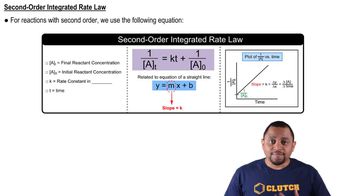
Step 2: Use the integrated rate law for a second-order reaction. The integrated rate law is \( \frac{1}{[A]_t} = \frac{1}{[A]_0} + kt \), where \( [A]_t \) is the concentration at time \( t \), \( [A]_0 \) is the initial concentration, and \( k \) is the rate constant.
Step 3: Substitute the given values into the integrated rate law. Here, \( [A]_0 = 0.0200 \text{ M} \), \( k = 4.0 \times 10^{-2} \text{ M}^{-1} \text{s}^{-1} \), and \( t = 1.00 \text{ h} \). Convert time from hours to seconds: \( 1.00 \text{ h} = 3600 \text{ s} \).
Step 4: Calculate \( \frac{1}{[A]_t} \) using the formula \( \frac{1}{[A]_t} = \frac{1}{0.0200} + (4.0 \times 10^{-2})(3600) \).
Step 5: Solve for \( [A]_t \) by taking the reciprocal of the result from Step 4 to find the concentration of C4H6 after 1.00 hour.
Concetti chiave
Ecco i concetti essenziali che devi comprendere per rispondere correttamente alla domanda.
Second-Order Reactions
A second-order reaction is one where the rate of reaction is proportional to the square of the concentration of one reactant or to the product of the concentrations of two reactants. For a reaction involving a single reactant, the rate law can be expressed as rate = k[C]^2, where k is the rate constant and [C] is the concentration of the reactant. This type of reaction typically leads to a specific integrated rate law that can be used to calculate concentration changes over time.
The integrated rate law for a second-order reaction can be expressed as 1/[A] = 1/[A]₀ + kt, where [A] is the concentration at time t, [A]₀ is the initial concentration, k is the rate constant, and t is the time elapsed. This equation allows us to determine the concentration of the reactant at any given time, making it essential for solving problems related to concentration changes in second-order kinetics.
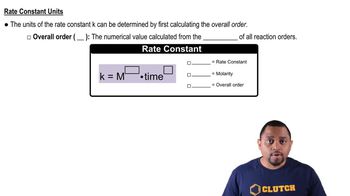
The units of the rate constant (k) for a second-order reaction are M^-1 s^-1, indicating that the rate of reaction depends on the concentration of the reactant squared. Understanding the units is crucial for ensuring that calculations involving the rate constant and concentrations are dimensionally consistent, which is necessary for accurate results in kinetics problems.