Ch.14 - Chemical Kinetics
McMurry - Chemistry 8th Edition
McMurry8th EditionChemistryISBN: 9781292336145Non è quello che usi tu?Cambia libro di testo
Capitolo 14, Problema 44

The following pictures represent the progress of a reaction in which two A molecules combine to give a more complex molecule A2, 2 AS A2. Three images showing the reaction progress of A molecules over time: 0, 1, and 2 minutes.
(b) What is the rate law?

Guida verificata passo dopo passo
1
Step 1: Identify the reaction given: 2A -> A2.
Step 2: Observe the images provided, noting the number of A molecules at each time interval (0 min, 1 min, 2 min).
Step 3: Determine the change in concentration of A molecules over time by counting the number of A molecules at each time interval.
Step 4: Use the rate law expression for a reaction of the form 2A -> A2, which is rate = k[A]^2, where k is the rate constant.
Step 5: Conclude that the rate law for this reaction is rate = k[A]^2, indicating a second-order reaction with respect to A.

Risposta video verificata per un problema simile:

Questa soluzione video è stata consigliata dai nostri tutor come utile per risolvere questo problema.
Durata del video:
3m

Concetti chiave

Ecco i concetti essenziali che devi comprendere per rispondere correttamente alla domanda.

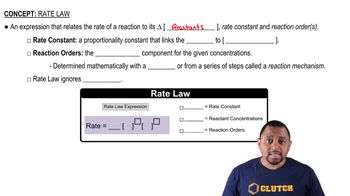
Rate Law

The rate law is an equation that relates the rate of a chemical reaction to the concentration of its reactants. It is typically expressed in the form rate = k[A]^m[B]^n, where k is the rate constant, and m and n are the orders of the reaction with respect to reactants A and B, respectively. Understanding the rate law is crucial for predicting how changes in concentration affect the reaction rate.
Video consigliato:
Percorso guidato
01:52
Rate Law Fundamentals

Reaction Order

Reaction order refers to the power to which the concentration of a reactant is raised in the rate law. It indicates how the rate of reaction is affected by the concentration of that reactant. For example, a first-order reaction means that the rate is directly proportional to the concentration of one reactant, while a second-order reaction indicates that the rate is proportional to the square of the concentration of that reactant.
Video consigliato:
Percorso guidato
00:36
Average Bond Order

Molecularity

Molecularity is the number of reactant molecules involved in an elementary reaction step. It can be unimolecular (one molecule), bimolecular (two molecules), or termolecular (three molecules). In the context of the given reaction, where two A molecules combine to form A2, the reaction is bimolecular, which is important for determining the rate law and understanding the mechanism of the reaction.
Video consigliato:
Percorso guidato
02:38
Molecular Polarity
Pratica correlata
Domanda del libro di testo
The relative rates of the reaction A + B S AB in vessels (1)–(3) are 4:4:1. Red spheres represent A molecules, and blue spheres represent B molecules. (1)-(3)

(a) What is the order of the reaction in A and B?
510
views

Domanda del libro di testo
What is the molecularity of each of the following elementary reactions? (a)

(b)

(c)

942
views
Domanda del libro di testo
Consider the first-order reaction AS B in which A molecules (red spheres) are converted to B molecules (blue spheres).

(a) Given the pictures at t = 0 min and t = 1 min, draw pictures that show the number of A and B molecules present at t = 2 min and t = 3 min.
766
views
Domanda del libro di testo

Consider a reaction that occurs by the following mechanism:

A + BC → AC + B

AC + D → A + CD

The potential energy profile for this reaction is as follows:

(b) Write structural formulas for all species present at reaction stages 1–5. Identify each species as a reactant, product, catalyst, intermediate, or transition state.

685
views
Domanda del libro di testo

The following pictures represent the progress of the reaction AS B in which A molecules (red spheres) are converted to B molecules (blue spheres).

(c) Suppose that each sphere represents 6.0⨉1021 molecules and that the volume of the container is 1.0 L. What is the rate constant for the reaction in the usual units?

519
views
Domanda del libro di testo

The following pictures represent the progress of the reaction AS B in which A molecules (red spheres) are converted to B molecules (blue spheres).

(b) Draw a picture that shows the number of A and B molecules present at t = 3 min.

620
views
1
rank