
Ch.14 - Chemical Kinetics
McMurry - Chemistry 8th Edition
McMurry8th EditionChemistryISBN: 9781292336145Non è quello che usi tu?Cambia libro di testo
Capitolo 14, Problema 137d

Values of Ea = 6.3 kJ/mol and A = 6.0⨉108/(M s) have been measured for the bimolecular reaction: NO(g) + F2(g) → NOF(g) + F(g) (d) Why does the reaction have such a low activation energy?

Guida verificata passo dopo passo
1
Understand that activation energy (E_a) is the minimum energy required for a reaction to occur. A low E_a means that the reactants can easily overcome the energy barrier to form products.
Consider the nature of the reactants and the reaction mechanism. NO and F_2 are both gases, which typically have higher kinetic energy and can collide more frequently and effectively, potentially lowering the activation energy.
Examine the bond strengths involved in the reaction. If the bonds being broken (e.g., F-F bond in F_2) are relatively weak compared to the bonds being formed (e.g., N-F bond in NOF), this can contribute to a lower activation energy.
Analyze the role of the pre-exponential factor (A) in the Arrhenius equation: k = A * e^(-E_a/RT). A high value of A suggests a high frequency of effective collisions, which can also contribute to a lower observed activation energy.
Consider any possible catalytic effects or reaction intermediates that might stabilize the transition state, thereby reducing the activation energy required for the reaction to proceed.

Risposta video verificata per un problema simile:

Questa soluzione video è stata consigliata dai nostri tutor come utile per risolvere questo problema.
Durata del video:
2m

Concetti chiave

Ecco i concetti essenziali che devi comprendere per rispondere correttamente alla domanda.

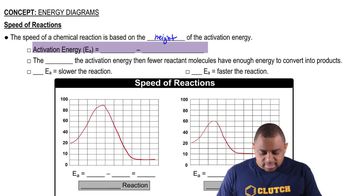
Activation Energy (E<sub>a</sub>)

Activation energy is the minimum energy required for a chemical reaction to occur. It represents the energy barrier that reactants must overcome to transform into products. A low activation energy, like the 6.3 kJ/mol in this reaction, indicates that the reaction can proceed easily, often leading to faster reaction rates.
Video consigliato:
Percorso guidato
02:02
Speed of Reactions

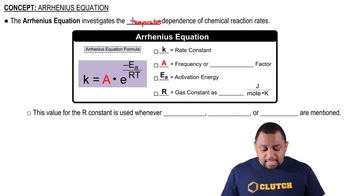
Arrhenius Equation

The Arrhenius equation relates the rate constant of a reaction to its activation energy and temperature. It is expressed as k = A * e^(-E<sub>a</sub>/RT), where k is the rate constant, A is the pre-exponential factor, R is the gas constant, and T is the temperature in Kelvin. A high pre-exponential factor (A = 6.0⨉10<sup>8</sup>/(M s)) suggests that the reaction has a high frequency of effective collisions, contributing to a faster reaction rate.
Video consigliato:
Percorso guidato
01:20
Arrhenius Equation

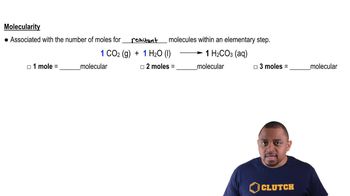
Bimolecular Reactions

Bimolecular reactions involve two reactant molecules colliding to form products. The rate of bimolecular reactions is typically dependent on the concentration of both reactants. In this case, the reaction between NO and F<sub>2</sub> is bimolecular, and the low activation energy indicates that the collision between these two species is energetically favorable, facilitating the reaction.
Video consigliato:
Percorso guidato
01:31
Molecularity in Reactions