Ch.14 - Chemical Kinetics
McMurry - Chemistry 8th Edition
McMurry8th EditionChemistryISBN: 9781292336145Non è quello che usi tu?Cambia libro di testo
Capitolo 14, Problema 87

Two reactions have the same activation energy, but their rates at the same temperature differ by a factor of 10. Explain.

Guida verificata passo dopo passo
1
Understand that the rate of a chemical reaction is influenced by the activation energy and the frequency factor (A) in the Arrhenius equation: k = A * e^(-Ea/RT).
Recognize that since the activation energies (Ea) are the same for both reactions, the difference in reaction rates must be due to the frequency factor (A).
Recall that the frequency factor (A) represents the number of times that reactants approach the activation barrier per unit time, which is influenced by factors such as molecular orientation and collision frequency.
Conclude that the reaction with the higher rate constant (k) has a higher frequency factor (A), meaning that the reactants are more likely to collide in the correct orientation to overcome the activation energy barrier.
Therefore, even with the same activation energy, the difference in reaction rates by a factor of 10 is due to a difference in the frequency factors of the two reactions.

Risposta video verificata per un problema simile:

Questa soluzione video è stata consigliata dai nostri tutor come utile per risolvere questo problema.
Durata del video:
2m

Concetti chiave

Ecco i concetti essenziali che devi comprendere per rispondere correttamente alla domanda.

Activation Energy

Activation energy is the minimum energy required for a chemical reaction to occur. It represents the energy barrier that reactants must overcome to transform into products. Even if two reactions have the same activation energy, other factors can influence their rates, such as the frequency of collisions and the orientation of reactants during those collisions.
Video consigliato:
Percorso guidato
02:02
Activity Series Chart

Rate of Reaction

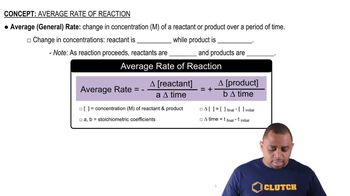
The rate of a reaction refers to how quickly reactants are converted into products. It is influenced by several factors, including concentration, temperature, and the presence of catalysts. In this case, even with the same activation energy, differences in the rate can arise from variations in these factors, particularly the frequency of effective collisions between reactant molecules.
Video consigliato:
Percorso guidato
02:03
Average Rate of Reaction

Arrhenius Equation

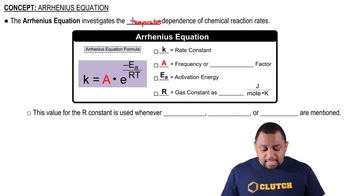
The Arrhenius equation describes the relationship between the rate constant of a reaction and temperature, incorporating activation energy. It is expressed as k = A * e^(-Ea/RT), where k is the rate constant, A is the pre-exponential factor, Ea is the activation energy, R is the gas constant, and T is the temperature in Kelvin. The pre-exponential factor can vary significantly between reactions, leading to differences in rates even when activation energies are identical.
Video consigliato:
Percorso guidato
01:20
Arrhenius Equation