Ch.14 - Chemical Kinetics
McMurry - Chemistry 8th Edition
McMurry8th EditionChemistryISBN: 9781292336145Non è quello che usi tu?Cambia libro di testo
Capitolo 14, Problema 84

Trans-cycloheptene 1C7H122, a strained cyclic hydrocarbon, converts to cis-cycloheptene at low temperatures. This molecular rearrangement is a second-order process with a rate constant of 0.030 M-1 s-1 at 60 °C. If the initial concentration of trans-cycloheptene is 0.035 M: (c) What is the half-life of trans-cycloheptene at an initial concentration of 0.075 M?

Guida verificata passo dopo passo
1
Identify that the problem involves a second-order reaction, which follows the rate law: \( \text{Rate} = k[A]^2 \), where \( k \) is the rate constant and \( [A] \) is the concentration of the reactant.
Recall the formula for the half-life of a second-order reaction: \( t_{1/2} = \frac{1}{k[A]_0} \), where \( [A]_0 \) is the initial concentration.
Substitute the given values into the half-life formula: \( k = 0.030 \, \text{M}^{-1} \text{s}^{-1} \) and \( [A]_0 = 0.075 \, \text{M} \).
Calculate the half-life using the formula: \( t_{1/2} = \frac{1}{0.030 \, \text{M}^{-1} \text{s}^{-1} \times 0.075 \, \text{M}} \).
Simplify the expression to find the half-life of trans-cycloheptene at the given initial concentration.

Risposta video verificata per un problema simile:

Questa soluzione video è stata consigliata dai nostri tutor come utile per risolvere questo problema.
Durata del video:
1m

Concetti chiave

Ecco i concetti essenziali che devi comprendere per rispondere correttamente alla domanda.

Second-Order Reactions

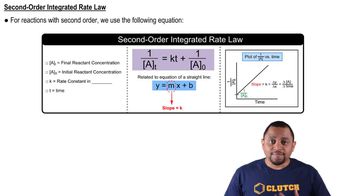
Second-order reactions are characterized by a rate that depends on the concentration of two reactants or the square of the concentration of a single reactant. The rate law for a second-order reaction can be expressed as rate = k[A]^2 or rate = k[A][B], where k is the rate constant. Understanding this concept is crucial for calculating reaction rates and half-lives in such reactions.
Video consigliato:
Percorso guidato
01:59
Second-Order Reactions

Half-Life of a Reaction

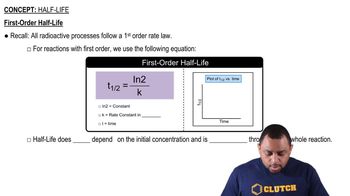
The half-life of a reaction is the time required for the concentration of a reactant to decrease to half of its initial value. For second-order reactions, the half-life is inversely proportional to the initial concentration, given by the formula t1/2 = 1/(k[A]0). This relationship is essential for determining how long it takes for a specific concentration of a reactant to diminish.
Video consigliato:
Percorso guidato
01:49
First-Order Half-Life

Arrhenius Equation

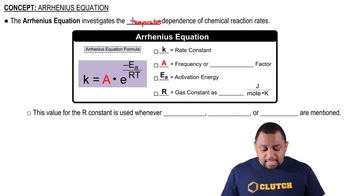
The Arrhenius equation describes how the rate constant (k) of a reaction changes with temperature, expressed as k = A * e^(-Ea/RT), where A is the pre-exponential factor, Ea is the activation energy, R is the gas constant, and T is the temperature in Kelvin. This concept is important for understanding how temperature influences reaction rates and can be applied to predict the behavior of reactions at different temperatures.
Video consigliato:
Percorso guidato
01:20
Arrhenius Equation