Ch.14 - Chemical Kinetics
McMurry - Chemistry 8th Edition
McMurry8th EditionChemistryISBN: 9781292336145Non è quello che usi tu?Cambia libro di testo
Capitolo 14, Problema 86

Why don't all collisions between reactant molecules lead to a chemical reaction?

Guida verificata passo dopo passo
1
insert step 1> Understand that not all collisions between reactant molecules result in a chemical reaction due to the concept of collision theory.
insert step 2> According to collision theory, for a reaction to occur, reactant molecules must collide with sufficient energy, known as the activation energy, to break bonds and form new ones.
insert step 3> Recognize that molecules must also collide with the correct orientation to allow the necessary rearrangement of atoms and formation of products.
insert step 4> Consider that even if molecules collide with the right orientation, if they do not have enough kinetic energy to overcome the activation energy barrier, the reaction will not proceed.
insert step 5> Realize that factors such as temperature, concentration, and the presence of a catalyst can influence the frequency and energy of collisions, thereby affecting the likelihood of a reaction occurring.

Risposta video verificata per un problema simile:

Questa soluzione video è stata consigliata dai nostri tutor come utile per risolvere questo problema.
Durata del video:
1m

Concetti chiave

Ecco i concetti essenziali che devi comprendere per rispondere correttamente alla domanda.

Collision Theory

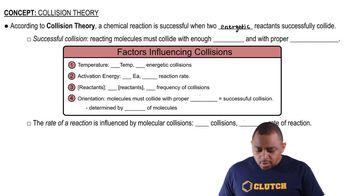
Collision theory posits that for a chemical reaction to occur, reactant molecules must collide with sufficient energy and proper orientation. Not all collisions result in a reaction because only those that meet these criteria can overcome the activation energy barrier, which is the minimum energy required for the reactants to transform into products.
Video consigliato:
Percorso guidato
02:08
Collision Theory

Activation Energy

Activation energy is the energy threshold that must be surpassed for a reaction to proceed. It represents the energy needed to break bonds in the reactants and form new bonds in the products. If the energy of the colliding molecules is below this threshold, the collision will not result in a reaction, regardless of how frequently collisions occur.
Video consigliato:
Percorso guidato
02:02
Activity Series Chart

Molecular Orientation

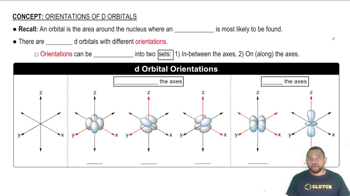
Molecular orientation refers to the specific alignment of reactant molecules during a collision. For a reaction to occur, the molecules must collide in a way that allows for the effective overlap of their electron clouds, facilitating bond formation. If the orientation is incorrect, even a collision with sufficient energy may not lead to a successful reaction.
Video consigliato:
Percorso guidato
02:06
d Orbital Orientations