Ch.15 - Chemical Equilibrium
McMurry - Chemistry 8th Edition
McMurry8th EditionChemistryISBN: 9781292336145Non è quello che usi tu?Cambia libro di testo
Capitolo 15, Problema 53

Identify the true statement about the concentrations of A and B once the reaction A ⇌ B has reached equilibrium. (a) The concentration of A equals the concentration of B. (b) The concentrations of A and B are constant. (c) The concentration of A decreases and the concentration of B increases. (d) The concentration of B decreases and the concentration of A increases.

Guida verificata passo dopo passo
1
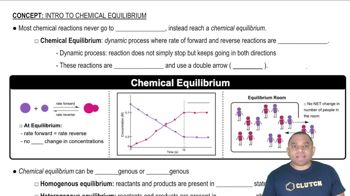
Step 1: Understand the concept of chemical equilibrium. At equilibrium, the rate of the forward reaction equals the rate of the reverse reaction, meaning the concentrations of reactants and products remain constant over time.
Step 2: Analyze each statement in the context of equilibrium. Statement (a) suggests that the concentrations of A and B are equal, which is not necessarily true at equilibrium unless the equilibrium constant dictates it.
Step 3: Evaluate statement (b). At equilibrium, the concentrations of A and B are indeed constant, as the rates of the forward and reverse reactions are equal.
Step 4: Consider statement (c). This describes a scenario where the reaction is still proceeding towards equilibrium, not a state of equilibrium itself.
Step 5: Assess statement (d). Similar to statement (c), this describes a non-equilibrium state where the reaction is still shifting towards equilibrium.

Concetti chiave

Ecco i concetti essenziali che devi comprendere per rispondere correttamente alla domanda.

Chemical Equilibrium

Chemical equilibrium occurs in a reversible reaction when the rates of the forward and reverse reactions are equal, resulting in constant concentrations of reactants and products. At this point, the system is in a dynamic state where the concentrations do not change over time, even though both reactions continue to occur.
Video consigliato:
Percorso guidato
04:21
Chemical Equilibrium Concepts

Concentration in Equilibrium

At equilibrium, the concentrations of reactants and products remain constant, but they do not have to be equal. This means that while the amounts of A and B may differ, their concentrations will stabilize at specific values determined by the reaction conditions and the equilibrium constant.
Video consigliato:
Percorso guidato
02:35
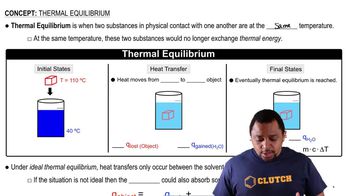
Thermal Equilibrium

Le Chatelier's Principle

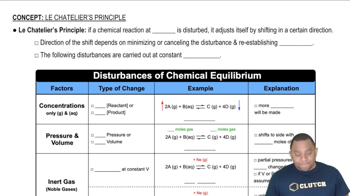
Le Chatelier's Principle states that if a system at equilibrium is subjected to a change in concentration, temperature, or pressure, the system will adjust to counteract that change and restore a new equilibrium. This principle helps predict how the concentrations of A and B will respond to external changes, but it does not imply that their concentrations will be equal.
Video consigliato:
Percorso guidato
07:32
Le Chatelier's Principle