
Ch.15 - Chemical Equilibrium
McMurry - Chemistry 8th Edition
McMurry8th EditionChemistryISBN: 9781292336145Non è quello che usi tu?Cambia libro di testo
Capitolo 15, Problema 52

Identify the true statement about the rate of the forward and reverse reaction once a reaction has reached equilibrium. (a) The rate of the forward reaction and the reverse reaction is zero. (b) The rate of the forward reaction is greater than the rate of the reverse reaction. (c) The rate of the reverse reaction is greater than the rate of the forward reaction. (d) The rate of the forward reaction is equal to the rate of the reverse reaction.

Guida verificata passo dopo passo
1
Understand the concept of chemical equilibrium, which occurs when the rate of the forward reaction equals the rate of the reverse reaction, and the concentrations of reactants and products remain constant over time.
Analyze option (a): If both the forward and reverse reactions had a rate of zero at equilibrium, no reactions would be occurring, which contradicts the dynamic nature of equilibrium where reactions continue to occur.
Evaluate option (b) and (c): If the rate of the forward reaction was greater than the reverse, or vice versa, the concentrations of reactants and products would continue to change, indicating that the system has not yet reached equilibrium.
Consider option (d): At equilibrium, the ongoing forward and reverse reactions occur at the same rate, which keeps the overall concentrations of reactants and products constant.
Conclude that the correct statement about the rates of the forward and reverse reactions at equilibrium is that they are equal, supporting option (d).

Risposta video verificata per un problema simile:

Questa soluzione video è stata consigliata dai nostri tutor come utile per risolvere questo problema.
Durata del video:
1m

Concetti chiave

Ecco i concetti essenziali che devi comprendere per rispondere correttamente alla domanda.

Chemical Equilibrium

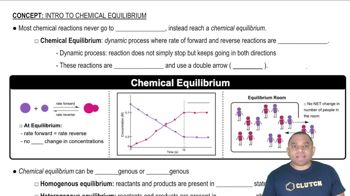
Chemical equilibrium occurs in a reversible reaction when the rates of the forward and reverse reactions become equal, resulting in no net change in the concentrations of reactants and products. At this point, the system is in a state of balance, and the concentrations remain constant over time.
Video consigliato:
Percorso guidato
04:21
Chemical Equilibrium Concepts

Reaction Rates

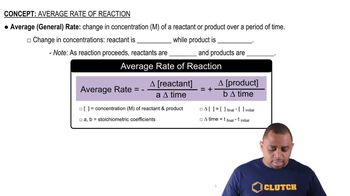
The rate of a reaction refers to the speed at which reactants are converted into products. In a reversible reaction, the forward rate is the speed of the reaction forming products, while the reverse rate is the speed of the reaction forming reactants. Understanding these rates is crucial for analyzing the behavior of a system at equilibrium.
Video consigliato:
Percorso guidato
02:03
Average Rate of Reaction

Dynamic Nature of Equilibrium

Equilibrium is dynamic, meaning that even though the concentrations of reactants and products remain constant, both the forward and reverse reactions continue to occur at equal rates. This dynamic balance is essential for understanding how systems respond to changes in conditions, such as concentration, temperature, or pressure.
Video consigliato:
Percorso guidato
01:26
Nature of Energy