Ch.16 - Aqueous Equilibria: Acids & Bases
McMurry - Chemistry 8th Edition
McMurry8th EditionChemistryISBN: 9781292336145Non è quello che usi tu?Cambia libro di testo
Capitolo 16, Problema 94

A vitamin C tablet containing 250 mg of ascorbic acid 1C6H8O6; Ka = 8.0 * 10-52 is dissolved in a 250 mL glass of water. What is the pH of the solution?

Guida verificata passo dopo passo
1
Convert the mass of ascorbic acid (250 mg) to moles using its molar mass (C_6H_8O_6).
Calculate the concentration of ascorbic acid in the solution by dividing the number of moles by the volume of the solution in liters (0.250 L).
Set up the expression for the acid dissociation constant (K_a) for ascorbic acid: K_a = [H^+][A^-]/[HA].
Assume that the initial concentration of H^+ and A^- is negligible and that the change in concentration of HA is equal to the concentration of H^+ at equilibrium.
Solve for [H^+] using the K_a expression and the initial concentration of ascorbic acid, then calculate the pH using the formula pH = -log[H^+].

Risposta video verificata per un problema simile:

Questa soluzione video è stata consigliata dai nostri tutor come utile per risolvere questo problema.
Durata del video:
15m

Concetti chiave

Ecco i concetti essenziali che devi comprendere per rispondere correttamente alla domanda.

Acid-Base Chemistry

Acid-base chemistry involves the study of acids, bases, and their reactions. Acids are substances that donate protons (H+ ions), while bases accept protons. The strength of an acid is often measured by its acid dissociation constant (Ka), which indicates how well it ionizes in solution. Understanding these principles is essential for calculating pH and determining the behavior of substances in aqueous solutions.
Video consigliato:
Percorso guidato
02:00
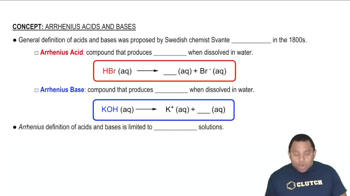
Arrhenius Acids and Bases

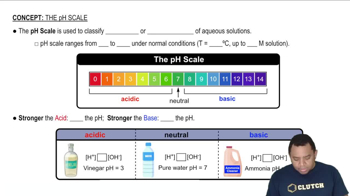
pH Scale

The pH scale quantifies the acidity or basicity of a solution, ranging from 0 to 14. A pH of 7 is neutral, below 7 is acidic, and above 7 is basic. The pH is calculated using the formula pH = -log[H+], where [H+] is the concentration of hydrogen ions in the solution. Knowing how to calculate pH is crucial for understanding the effects of acids and bases in chemical reactions.
Video consigliato:

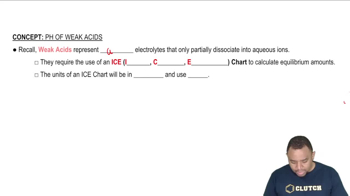
Dissociation of Weak Acids

Weak acids, like ascorbic acid, do not fully dissociate in solution, meaning only a fraction of the acid molecules release protons. The degree of dissociation can be described using the acid dissociation constant (Ka). For ascorbic acid, the given Ka value indicates its weak acidic nature, which is important for calculating the concentration of hydrogen ions and, consequently, the pH of the solution after dissolving the vitamin C tablet.
Video consigliato:
Percorso guidato
00:44
ICE Charts of Weak Acids