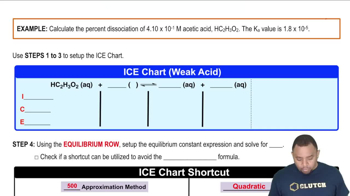
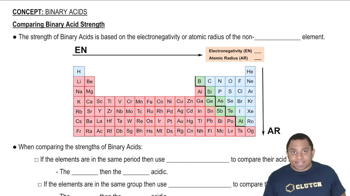
Look up the values of Ka in Appendix C for C6H5OH, HNO3, CH3CO2H, and HOCl, and arrange these acids in order of: (b) Decreasing percent dissociation.
Guida verificata passo dopo passo
1
insert step 1: Understand that the percent dissociation of an acid is related to its acid dissociation constant (Ka). A higher Ka value indicates a stronger acid, which typically dissociates more in solution.
insert step 2: Look up the Ka values for each acid: C6H5OH (phenol), HNO3 (nitric acid), CH3CO2H (acetic acid), and HOCl (hypochlorous acid) in Appendix C.
insert step 3: Compare the Ka values. The acid with the highest Ka value will have the greatest percent dissociation, while the acid with the lowest Ka value will have the least percent dissociation.
insert step 4: Arrange the acids in order of decreasing percent dissociation based on their Ka values.
insert step 5: Verify the order by considering the nature of each acid: strong acids like HNO3 will have a higher percent dissociation compared to weak acids like CH3CO2H and C6H5OH.
Risposta video verificata per un problema simile:
Questa soluzione video è stata consigliata dai nostri tutor come utile per risolvere questo problema.
Durata del video:
17m
Guarda un video:
0 Commenti
Concetti chiave
Ecco i concetti essenziali che devi comprendere per rispondere correttamente alla domanda.
Acid Dissociation Constant (Ka)
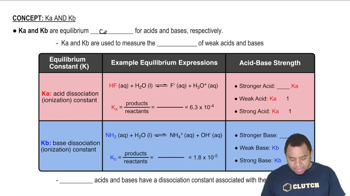
The acid dissociation constant, Ka, quantifies the strength of an acid in solution. It is defined as the equilibrium constant for the dissociation of an acid into its conjugate base and a proton. A higher Ka value indicates a stronger acid, which dissociates more completely in solution, leading to a greater concentration of hydrogen ions.
Percent dissociation refers to the fraction of the original acid that has dissociated into ions at equilibrium, expressed as a percentage. It is calculated by dividing the concentration of dissociated acid by the initial concentration and multiplying by 100. This concept helps compare the strength of different acids in terms of their ability to release protons in solution.
When comparing acids, the strength can be inferred from both the Ka values and the percent dissociation. Generally, stronger acids (higher Ka) will have a higher percent dissociation in a given concentration. However, the percent dissociation can also be influenced by the concentration of the acid; weaker acids may show a higher percent dissociation at lower concentrations, complicating direct comparisons.


 Guida verificata passo dopo passo
 03:50
03:50