Ch.16 - Aqueous Equilibria: Acids & Bases
McMurry - Chemistry 8th Edition
McMurry8th EditionChemistryISBN: 9781292336145Non è quello che usi tu?Cambia libro di testo
Capitolo 16, Problema 92

The equivalence point was reached in titrations of three unknown bases at pH 5.53 (base A), 4.11 (base B), and 6.00 (base C). (a) Which is the strongest base? (b) Which is the weakest base?

Guida verificata passo dopo passo
1
insert step 1> Determine the relationship between the pH at the equivalence point and the strength of the base being titrated.
insert step 2> Recall that the equivalence point in a titration of a weak base with a strong acid occurs when the moles of acid equal the moles of base, and the solution contains the conjugate acid of the base.
insert step 3> Understand that the pH at the equivalence point is influenced by the strength of the conjugate acid formed. A higher pH at the equivalence point indicates a weaker conjugate acid, which corresponds to a stronger original base.
insert step 4> Compare the given pH values at the equivalence points: 5.53 for base A, 4.11 for base B, and 6.00 for base C.
insert step 5> Conclude that the base with the highest pH at the equivalence point is the strongest base, and the base with the lowest pH at the equivalence point is the weakest base.

Risposta video verificata per un problema simile:

Questa soluzione video è stata consigliata dai nostri tutor come utile per risolvere questo problema.
Durata del video:
1m

Concetti chiave

Ecco i concetti essenziali che devi comprendere per rispondere correttamente alla domanda.

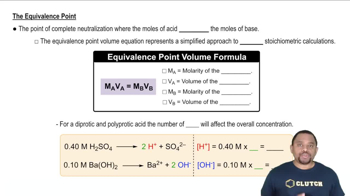
Equivalence Point in Titration

The equivalence point in a titration is the stage at which the amount of titrant added is stoichiometrically equivalent to the amount of substance in the sample. At this point, the reaction between the acid and base is complete, and the pH can indicate the strength of the acid or base involved. The pH at the equivalence point varies depending on the strengths of the acids and bases being titrated.
Video consigliato:
Percorso guidato
03:06
Equivalence Point in Titration

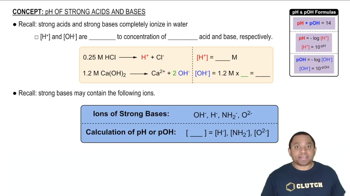
pH and Strength of Bases

The pH scale measures the acidity or basicity of a solution, with lower values indicating stronger acids and higher values indicating stronger bases. In the context of titration, a higher pH at the equivalence point suggests a stronger base, as it indicates that the base is less likely to donate protons compared to weaker bases. Therefore, comparing the pH values at the equivalence points helps determine the relative strengths of the bases.
Video consigliato:
Percorso guidato
02:39
pH of Strong Acids and Bases

Relationship Between pH and Base Strength

The relationship between pH and base strength is crucial in determining the relative strength of bases. Stronger bases will result in higher pH values at their equivalence points due to their greater ability to accept protons. Conversely, weaker bases will yield lower pH values at the equivalence point, indicating a lesser capacity to neutralize acids. This relationship allows for the identification of the strongest and weakest bases among those tested.
Video consigliato:
Percorso guidato
02:39
pH of Strong Acids and Bases