Ch.16 - Aqueous Equilibria: Acids & Bases
McMurry - Chemistry 8th Edition
McMurry8th EditionChemistryISBN: 9781292336145Non è quello che usi tu?Cambia libro di testo
Capitolo 16, Problema 57

Choose from the conjugate acid–base pairs F- > HF, NH3 > NH4+, and NO3- > HNO3, to complete the following equation with the pair that gives an equilibrium constant Kc > 1. _____ + H2CO3 ⇌ _____ + HCO3-

Guida verificata passo dopo passo
1
Step 1: Identify the role of each species in the given equation. H2CO3 is a weak acid, and HCO3- is its conjugate base. The equation represents an acid-base reaction where a base reacts with H2CO3 to form its conjugate acid and HCO3-.
Step 2: Understand the concept of equilibrium constant (Kc). A Kc > 1 indicates that the products are favored at equilibrium, meaning the forward reaction is more favorable than the reverse reaction.
Step 3: Analyze the given conjugate acid-base pairs: F- > HF, NH3 > NH4+, and NO3- > HNO3. Determine which pair has a stronger base that can effectively react with H2CO3 to produce a Kc > 1.
Step 4: Compare the basicity of the bases in each pair. F- is a weak base, NH3 is a moderate base, and NO3- is a very weak base. A stronger base will more likely react with H2CO3 to favor the formation of products.
Step 5: Choose the conjugate acid-base pair where the base is strong enough to react with H2CO3, resulting in a Kc > 1. Consider the strength of the base and the stability of the conjugate acid formed.

Concetti chiave

Ecco i concetti essenziali che devi comprendere per rispondere correttamente alla domanda.

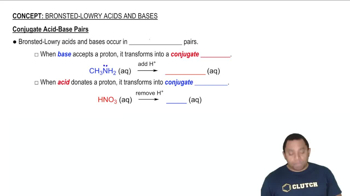
Conjugate Acid-Base Pairs

Conjugate acid-base pairs consist of two species that differ by the presence or absence of a proton (H+). When an acid donates a proton, it forms its conjugate base, while a base that accepts a proton forms its conjugate acid. Understanding these pairs is crucial for predicting the direction of acid-base reactions and the strength of acids and bases involved.
Video consigliato:
Percorso guidato
01:30
Conjugate Acid-Base Pairs

Equilibrium Constant (Kc)

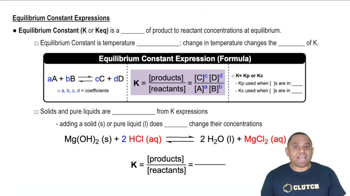
The equilibrium constant (Kc) quantifies the ratio of the concentrations of products to reactants at equilibrium for a given reaction. A Kc value greater than 1 indicates that products are favored at equilibrium, while a value less than 1 suggests that reactants are favored. This concept is essential for determining which conjugate acid-base pair will shift the equilibrium towards products in the given reaction.
Video consigliato:
Percorso guidato
03:20
Equilibrium Constant Expressions

Acid-Base Strength

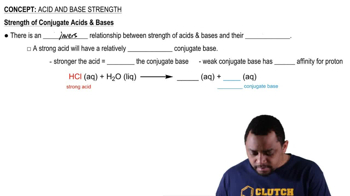
The strength of an acid or base is determined by its ability to donate or accept protons, respectively. Strong acids completely dissociate in solution, while weak acids only partially dissociate. In the context of the question, identifying the stronger base from the conjugate pairs will help predict which pair will effectively react with H2CO3 to produce HCO3- and shift the equilibrium towards products.
Video consigliato:
Percorso guidato
00:50
Strength of Conjugate Acids and Bases