Ch.16 - Aqueous Equilibria: Acids & Bases
McMurry - Chemistry 8th Edition
McMurry8th EditionChemistryISBN: 9781292336145Non è quello che usi tu?Cambia libro di testo
Capitolo 16, Problema 3

Consider the conjugate bases, 1X-, Y-, Z-2 in Problem 2. If you mix equal concentrations of reactants and products, which of the following reactions will proceed to the left? (LO 16.3) (a) HX + Y- HY + X- (b) HX + Z- HZ + X- (c) HY + X- HX + Y- (d) HZ + Y- HY + Z-Molecular representations of HX, HY, and HZ in acid-base equilibrium.

Guida verificata passo dopo passo
1
Identify the acids and their conjugate bases in each reaction. For example, in reaction (a) HX is the acid and X- is its conjugate base, while HY is the acid and Y- is its conjugate base.
Determine the relative strengths of the acids and bases involved. Stronger acids have weaker conjugate bases and vice versa.
Compare the acid strengths of the reactants and products. The reaction will proceed to the left if the products form a stronger acid and a weaker conjugate base compared to the reactants.
Analyze each reaction: (a) Compare HX and HY, (b) Compare HX and HZ, (c) Compare HY and HX, (d) Compare HZ and HY.
Determine which reaction has the products forming a stronger acid and a weaker conjugate base than the reactants, indicating the reaction will proceed to the left.

Risposta video verificata per un problema simile:

Questa soluzione video è stata consigliata dai nostri tutor come utile per risolvere questo problema.
Durata del video:
2m

Concetti chiave

Ecco i concetti essenziali che devi comprendere per rispondere correttamente alla domanda.

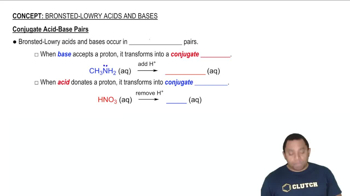
Conjugate Acid-Base Pairs

In acid-base chemistry, a conjugate acid-base pair consists of two species that differ by the presence of a proton (H+). When an acid donates a proton, it forms its conjugate base, while the base that accepts the proton becomes its conjugate acid. Understanding these pairs is crucial for predicting the direction of acid-base reactions.
Video consigliato:
Percorso guidato
01:30
Conjugate Acid-Base Pairs

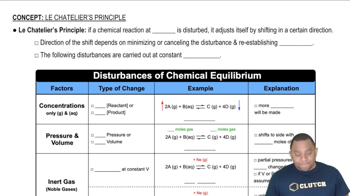
Le Chatelier's Principle

Le Chatelier's Principle states that if a dynamic equilibrium is disturbed by changing the conditions, the system will adjust to counteract the change and restore a new equilibrium. This principle helps predict how the concentration of reactants and products will shift in response to changes in concentration, pressure, or temperature.
Video consigliato:
Percorso guidato
07:32
Le Chatelier's Principle

Equilibrium Constant (K)

The equilibrium constant (K) quantifies the ratio of the concentrations of products to reactants at equilibrium for a given reaction at a specific temperature. A larger K value indicates a greater concentration of products at equilibrium, while a smaller K suggests that reactants are favored. This concept is essential for determining the direction in which a reaction will proceed.
Video consigliato:
Percorso guidato
01:14
Equilibrium Constant K