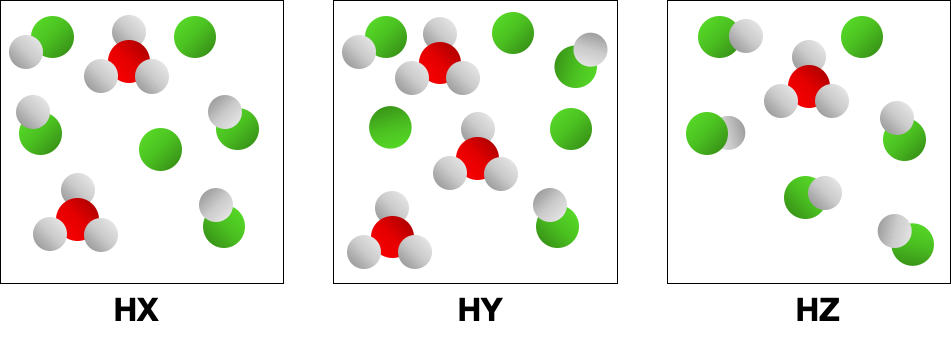
The following pictures represent equal volumes of aqueous
solutions of three acids HA (A = X, Y, or Z); water molecules
have been omitted for clarity. Which is the strongest
acid?
(a) HX
(b) HY
(c) HZ
(d) All three acids are strong acids and have equal strength.
Guida verificata passo dopo passo
1
Identify the dissociation of each acid in the given images. The green spheres represent the conjugate base (A-), the red spheres represent the hydrogen ions (H+), and the white spheres represent the undissociated acid molecules (HA).
Count the number of dissociated hydrogen ions (H+) for each acid. The more H+ ions present, the stronger the acid.
Compare the number of dissociated H+ ions for HX, HY, and HZ.
Determine which acid has the highest number of dissociated H+ ions, indicating it is the strongest acid.
Conclude which acid (HX, HY, or HZ) is the strongest based on the dissociation comparison.
Risposta video verificata per un problema simile:
Questa soluzione video è stata consigliata dai nostri tutor come utile per risolvere questo problema.
Durata del video:
2m
Guarda un video:
0 Commenti
Concetti chiave
Ecco i concetti essenziali che devi comprendere per rispondere correttamente alla domanda.
Acid Strength
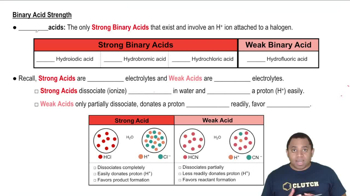
Acid strength refers to the ability of an acid to donate protons (H⁺ ions) in solution. Strong acids completely dissociate in water, releasing all their protons, while weak acids only partially dissociate. The strength of an acid is often determined by its dissociation constant (Ka), with larger values indicating stronger acids.
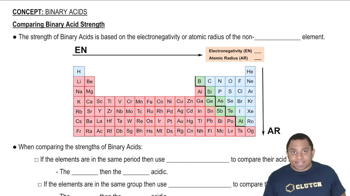
The molecular structure and polarity of an acid influence its strength. Acids with highly electronegative atoms or groups can stabilize the negative charge of the conjugate base after proton donation, making them stronger. The arrangement of atoms and the presence of electronegative elements can affect the acid's ability to release protons.
To determine which acid is the strongest among several, a comparative analysis of their structures and dissociation behaviors is necessary. This involves examining factors such as bond strength, electronegativity, and the stability of the resulting conjugate bases. By evaluating these characteristics, one can predict which acid will more readily donate protons in solution.