Ch.16 - Aqueous Equilibria: Acids & Bases
McMurry - Chemistry 8th Edition
McMurry8th EditionChemistryISBN: 9781292336145Non è quello che usi tu?Cambia libro di testo
Capitolo 16, Problema 5

What is the concentration of hydroxide ions 3OH-4 in a glass of wine with pH = 3.64? (LO 16.5, 16.6) (a) 2.3 * 10-4 M (b) 6.4 * 10-3 M (c) 6.8 * 10-9 M (d) 4.4 * 10-11 M

Guida verificata passo dopo passo
1
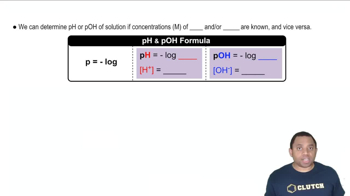
Step 1: Understand the relationship between pH and pOH. The pH and pOH of a solution are related by the equation: pH + pOH = 14.
Step 2: Calculate the pOH of the solution. Since the pH is given as 3.64, use the equation from Step 1 to find pOH: pOH = 14 - pH.
Step 3: Convert the pOH to the concentration of hydroxide ions [OH^-]. Use the formula: [OH^-] = 10^{-pOH}.
Step 4: Calculate the [OH^-] using the value of pOH obtained in Step 2.
Step 5: Compare the calculated [OH^-] with the given options to determine the correct answer.

Risposta video verificata per un problema simile:

Questa soluzione video è stata consigliata dai nostri tutor come utile per risolvere questo problema.
Durata del video:
1m

Concetti chiave

Ecco i concetti essenziali che devi comprendere per rispondere correttamente alla domanda.

pH and pOH Relationship

The pH scale measures the acidity or basicity of a solution, with lower values indicating higher acidity. The relationship between pH and pOH is given by the equation pH + pOH = 14 at 25°C. To find the concentration of hydroxide ions (OH-), one must first calculate the pOH from the given pH and then use the formula [OH-] = 10^(-pOH).
Video consigliato:
Percorso guidato
02:09
pH and pOH Calculations

Ion Concentration Calculation

The concentration of ions in a solution can be determined using the formula [H+] = 10^(-pH) for hydrogen ions. Once the concentration of hydrogen ions is known, the concentration of hydroxide ions can be calculated using the ion product of water (Kw = [H+][OH-] = 1.0 x 10^-14 at 25°C). This relationship allows for the determination of hydroxide ion concentration from the known pH.
Video consigliato:
Percorso guidato
07:35
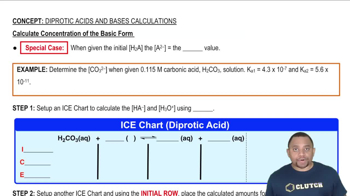
Calculate Concentration of the Basic Form

Logarithmic Scale of pH

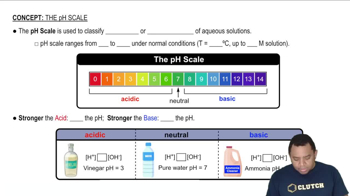
The pH scale is logarithmic, meaning each whole number change on the scale represents a tenfold change in hydrogen ion concentration. For example, a solution with a pH of 3 has ten times more hydrogen ions than a solution with a pH of 4. This property is crucial for accurately calculating ion concentrations from pH values, as small changes in pH can lead to significant differences in ion concentration.
Video consigliato: