Calculate the equilibrium constant at 25 °C for the reaction
Guida verificata passo dopo passo
1
Step 1: Identify the balanced chemical equation for the reaction. This will help you determine the stoichiometry of the reactants and products involved.
Step 2: Write the expression for the equilibrium constant, K, using the balanced chemical equation. The general form is K = [products]^coefficients / [reactants]^coefficients, where the concentrations are at equilibrium.
Step 3: Determine the standard Gibbs free energy change (ΔG°) for the reaction at 25 °C. This can be done using tabulated standard Gibbs free energies of formation for the reactants and products.
Step 4: Use the relationship between the equilibrium constant and the Gibbs free energy change: ΔG° = -RT ln(K), where R is the universal gas constant (8.314 J/mol·K) and T is the temperature in Kelvin (298 K for 25 °C).
Step 5: Rearrange the equation from Step 4 to solve for the equilibrium constant, K, by calculating K = e^(-ΔG°/RT).
Concetti chiave
Ecco i concetti essenziali che devi comprendere per rispondere correttamente alla domanda.
Equilibrium Constant (K)
The equilibrium constant (K) is a numerical value that expresses the ratio of the concentrations of products to reactants at equilibrium for a given chemical reaction at a specific temperature. It provides insight into the extent of the reaction; a large K indicates that products are favored, while a small K suggests that reactants are favored.
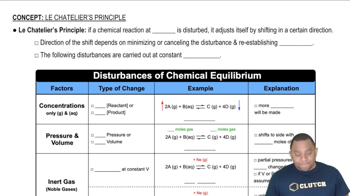
Le Chatelier's Principle states that if a system at equilibrium is subjected to a change in concentration, temperature, or pressure, the system will adjust to counteract that change and restore a new equilibrium. This principle helps predict how changes will affect the position of equilibrium and the value of the equilibrium constant.
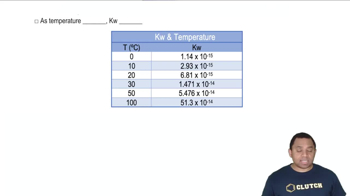
The value of the equilibrium constant (K) is temperature-dependent, meaning it can change with variations in temperature. For exothermic reactions, increasing temperature typically decreases K, while for endothermic reactions, increasing temperature usually increases K. Understanding this relationship is crucial for calculating K at different temperatures.


 Guida verificata passo dopo passo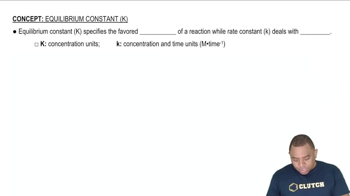
 01:14
01:14