Ch.19 - Electrochemistry
McMurry - Chemistry 8th Edition
McMurry8th EditionChemistryISBN: 9781292336145Non è quello che usi tu?Cambia libro di testo
Capitolo 19, Problema 150a

Chlorine can be prepared in the laboratory by the reaction of hydrochloric acid and potassium permanganate. (a) Use data in Appendix D to write a balanced equation for the reaction. The reduction product is Mn2+.

Guida verificata passo dopo passo
1
Identify the reactants and products: Hydrochloric acid (HCl) and potassium permanganate (KMnO4) react to produce chlorine gas (Cl2), manganese(II) ions (Mn2+), and other products.
Write the unbalanced chemical equation: \( \text{HCl} + \text{KMnO}_4 \rightarrow \text{Cl}_2 + \text{Mn}^{2+} + \text{KCl} + \text{H}_2\text{O} \).
Balance the atoms in the equation starting with the manganese (Mn) atoms: Ensure that the number of Mn atoms on both sides of the equation is equal.
Balance the chlorine (Cl) atoms: Since Cl appears in both HCl and Cl2, adjust the coefficients to balance the Cl atoms.
Balance the remaining atoms (H, O, and K) by adjusting the coefficients of HCl, H2O, and KCl, ensuring that the number of each type of atom is equal on both sides of the equation.

Risposta video verificata per un problema simile:

Questa soluzione video è stata consigliata dai nostri tutor come utile per risolvere questo problema.
Durata del video:
6m

Concetti chiave

Ecco i concetti essenziali che devi comprendere per rispondere correttamente alla domanda.

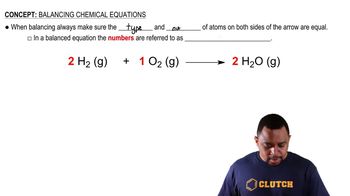
Balancing Chemical Equations

Balancing chemical equations involves ensuring that the number of atoms for each element is the same on both sides of the equation. This is based on the law of conservation of mass, which states that matter cannot be created or destroyed in a chemical reaction. To balance an equation, coefficients are adjusted in front of the chemical formulas to achieve equal atom counts.
Video consigliato:
Percorso guidato
01:32
Balancing Chemical Equations

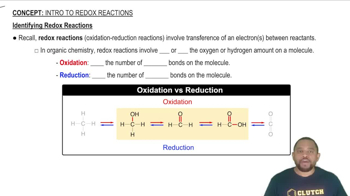
Redox Reactions

Redox reactions, or reduction-oxidation reactions, involve the transfer of electrons between species. In these reactions, one substance is oxidized (loses electrons) while another is reduced (gains electrons). Understanding the oxidation states of the elements involved is crucial for identifying which species undergo reduction and oxidation during the reaction.
Video consigliato:
Percorso guidato
03:12
Identifying Redox Reactions

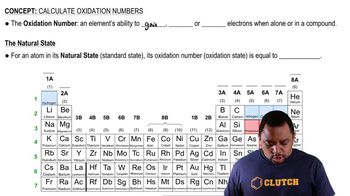
Oxidation States

Oxidation states (or oxidation numbers) are assigned to atoms in a compound to indicate their degree of oxidation or reduction. They help in tracking electron transfer in redox reactions. For example, in the reaction between hydrochloric acid and potassium permanganate, the manganese in permanganate is reduced from an oxidation state of +7 to +2, indicating a gain of electrons.
Video consigliato:
Percorso guidato
02:42
Oxidation Numbers