Ch.19 - Electrochemistry
McMurry - Chemistry 8th Edition
McMurry8th EditionChemistryISBN: 9781292336145Non è quello che usi tu?Cambia libro di testo
Capitolo 19, Problema 151

The sodium–sulfur battery has molybdenum electrodes with anode and cathode compartments separated by b-alumina, a ceramic through which sodium ions can pass. Because the battery operates at temperatures above 300 °C, all the reactants and products are present in a molten solution. The cell voltage is about 2.0 V. (b) How many kilograms of sodium are consumed when a 25 kW sodium–sulfur battery produces current for 32 min?

Guida verificata passo dopo passo
1
Step 1: Calculate the total energy produced by the battery. Use the formula: Energy (in kWh) = Power (in kW) × Time (in hours). Convert 32 minutes into hours.
Step 2: Convert the energy from kWh to joules. Use the conversion factor: 1 kWh = 3.6 × 10^6 J.
Step 3: Calculate the total charge (in coulombs) using the formula: Charge (Q) = Energy (in joules) / Voltage (in volts). Here, the voltage is given as 2.0 V.
Step 4: Use Faraday's laws of electrolysis to find the moles of sodium consumed. The formula is: Moles of Na = Charge (Q) / (n × F), where n is the number of electrons transferred per mole of Na (n = 1 for Na), and F is Faraday's constant (approximately 96485 C/mol).
Step 5: Convert the moles of sodium to mass in kilograms. Use the molar mass of sodium (approximately 22.99 g/mol) and convert grams to kilograms.

Risposta video verificata per un problema simile:

Questa soluzione video è stata consigliata dai nostri tutor come utile per risolvere questo problema.
Durata del video:
5m

Concetti chiave

Ecco i concetti essenziali che devi comprendere per rispondere correttamente alla domanda.

Electrochemical Cells

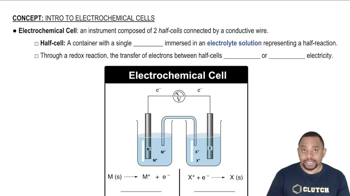
Electrochemical cells, such as batteries, convert chemical energy into electrical energy through redox reactions. In a sodium-sulfur battery, sodium ions move through a ceramic electrolyte, allowing for the flow of electric current. Understanding the operation of these cells is crucial for calculating the amount of reactants consumed during the battery's operation.
Video consigliato:
Percorso guidato
02:46
Electrochemical Cells

Current and Charge

Current is the flow of electric charge, measured in amperes (A), and is related to the amount of charge (in coulombs) that passes through a circuit over time. The relationship between current, charge, and time is given by the equation Q = I × t, where Q is charge, I is current, and t is time. This concept is essential for determining how much sodium is consumed based on the current produced by the battery.
Video consigliato:

Molar Mass and Stoichiometry

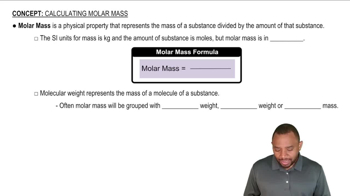
Molar mass is the mass of one mole of a substance, typically expressed in grams per mole. Stoichiometry involves the calculation of reactants and products in chemical reactions based on balanced equations. In this context, knowing the molar mass of sodium allows for the conversion of the total charge produced by the battery into the mass of sodium consumed, facilitating the final calculation.
Video consigliato:
Percorso guidato
02:11
Molar Mass Concept