Ch.19 - Electrochemistry
McMurry - Chemistry 8th Edition
McMurry8th EditionChemistryISBN: 9781292336145Non è quello che usi tu?Cambia libro di testo
Capitolo 19, Problema 122

For a lead storage battery: (a) Sketch one cell that shows the anode, cathode, electrolyte, direction of electron and ion flow, and sign of the electrodes. (b) Write the anode, cathode, and overall cell reactions. (c) Calculate the equilibrium constant for the cell reaction (E° = 1.924 V). (d) What is the cell voltage when the cell reaction reaches equilibrium?

Guida verificata passo dopo passo
1
Step 1: Understand the components of a lead storage battery. The anode is made of lead (Pb), the cathode is lead dioxide (PbO2), and the electrolyte is sulfuric acid (H2SO4). Electrons flow from the anode to the cathode through an external circuit, while ions move through the electrolyte.
Step 2: Write the half-reactions for the anode and cathode. At the anode, lead is oxidized: \( \text{Pb} \rightarrow \text{Pb}^{2+} + 2\text{e}^- \). At the cathode, lead dioxide is reduced: \( \text{PbO}_2 + 4\text{H}^+ + 2\text{e}^- \rightarrow \text{Pb}^{2+} + 2\text{H}_2\text{O} \).
Step 3: Combine the half-reactions to write the overall cell reaction. Ensure that the electrons cancel out: \( \text{Pb} + \text{PbO}_2 + 4\text{H}^+ \rightarrow 2\text{Pb}^{2+} + 2\text{H}_2\text{O} \).
Step 4: Use the Nernst equation to calculate the equilibrium constant \( K \) for the cell reaction. The equation is \( E^\circ = \frac{RT}{nF} \ln K \), where \( E^\circ \) is the standard cell potential, \( R \) is the gas constant, \( T \) is the temperature in Kelvin, \( n \) is the number of moles of electrons transferred, and \( F \) is Faraday's constant.
Step 5: Determine the cell voltage at equilibrium. At equilibrium, the cell voltage is zero because the forward and reverse reactions occur at the same rate, and there is no net electron flow.

Concetti chiave

Ecco i concetti essenziali che devi comprendere per rispondere correttamente alla domanda.

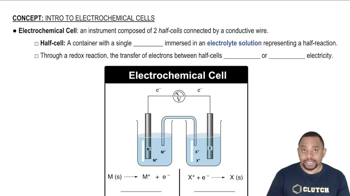
Electrochemical Cells

Electrochemical cells consist of two electrodes (anode and cathode) immersed in an electrolyte, facilitating redox reactions. The anode is where oxidation occurs, releasing electrons, while the cathode is where reduction takes place, accepting electrons. Understanding the flow of electrons and ions is crucial for analyzing the cell's operation and sketching its components accurately.
Video consigliato:
Percorso guidato
02:46
Electrochemical Cells

Cell Reactions and Standard Electrode Potentials

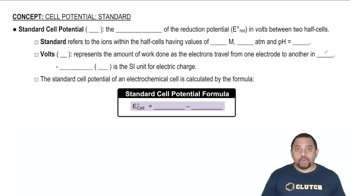
Cell reactions in electrochemical cells involve the transfer of electrons between the anode and cathode, which can be represented by half-reactions. The standard electrode potential (E°) quantifies the tendency of a species to gain electrons, influencing the overall cell reaction. Writing the anode and cathode reactions is essential for calculating the overall cell reaction and its equilibrium constant.
Video consigliato:
Percorso guidato
01:27
Standard Cell Potential

Equilibrium Constant and Cell Voltage

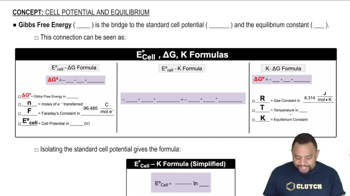
The equilibrium constant (K) for a cell reaction can be calculated using the Nernst equation, which relates the standard cell potential (E°) to the concentrations of reactants and products at equilibrium. At equilibrium, the cell voltage drops to zero, indicating no net reaction occurs. Understanding how to calculate K and interpret cell voltage is vital for predicting the behavior of the electrochemical cell under different conditions.
Video consigliato:
Percorso guidato
02:38
Cell Potential and Equilibrium
Pratica correlata
Domanda del libro di testo

A mercury battery uses the following electrode half-reactions: (c) What is the effect on the cell voltage of a tenfold change in the concentration of KOH in the electrolyte? Explain..

454
views

Domanda del libro di testo

A storm has knocked out power to your beach house, and you would like to build a battery from household items to charge your iPhone. You have the following materials. alum in the kitchen, which can be used to make a 1.0 M Al3+ solution bleach, which is a solution that is approximately a 1.0 M in ClO-aluminum foil, a platinum necklace and bologna, which can be used as a salt bridge (b) What voltage can be generated?

290
views
Domanda del libro di testo
How does the pH of the solution affect the formation of rust?
573
views
Domanda del libro di testo

A storm has knocked out power to your beach house, and you would like to build a battery from household items to charge your iPhone. You have the following materials. alum in the kitchen, which can be used to make a 1.0 M Al3+ solution bleach, which is a solution that is approximately a 1.0 M in ClO-aluminum foil, a platinum necklace and bologna, which can be used as a salt bridge (a) What are the half-reactions and overall reaction in the battery?

203
views
Domanda del libro di testo

A mercury battery uses the following electrode half-reactions: (b) Calculate ∆G° (in kilojoules) and K at 25 °C for the cell reaction.

747
views
Domanda del libro di testo

A storm has knocked out power to your beach house, and you would like to build a battery from household items to charge your iPhone. You have the following materials. alum in the kitchen, which can be used to make a 1.0 M Al3+ solution bleach, which is a solution that is approximately a 1.0 M in ClO-aluminum foil, a platinum necklace and bologna, which can be used as a salt bridge (d) An iPhone requires 5.0 V for charging. Can this battery charge the phone? Explain.

1
views