Ch.19 - Electrochemistry
McMurry - Chemistry 8th Edition
McMurry8th EditionChemistryISBN: 9781292336145Non è quello che usi tu?Cambia libro di testo
Capitolo 19, Problema 38

Sketch a cell with inert electrodes suitable for electrolysis of aqueous CuBr2. (b) Indicate the direction of electron and ion flow.

Guida verificata passo dopo passo
1
insert step 1: Identify the components of the electrolysis cell. You will need an electrolyte solution, which is aqueous CuBr2, and inert electrodes, such as platinum or graphite, to conduct electricity.
insert step 2: Sketch the electrolysis cell. Draw a container to represent the electrolyte solution, and place the two inert electrodes into the solution. Label one electrode as the anode and the other as the cathode.
insert step 3: Determine the reactions at each electrode. At the anode, oxidation occurs, and at the cathode, reduction occurs. For CuBr2, copper ions (Cu^2+) will be reduced at the cathode, and bromide ions (Br^-) will be oxidized at the anode.
insert step 4: Indicate the direction of electron flow. Electrons flow from the anode to the cathode through the external circuit.
insert step 5: Indicate the direction of ion flow. In the solution, Cu^2+ ions move towards the cathode to gain electrons, and Br^- ions move towards the anode to lose electrons.

Risposta video verificata per un problema simile:

Questa soluzione video è stata consigliata dai nostri tutor come utile per risolvere questo problema.
Durata del video:
3m

Concetti chiave

Ecco i concetti essenziali che devi comprendere per rispondere correttamente alla domanda.

Electrolysis

Electrolysis is a chemical process that uses electrical energy to drive a non-spontaneous reaction. In this process, an electric current is passed through an electrolyte, causing the decomposition of the compound into its constituent ions. For aqueous CuBr2, electrolysis will lead to the formation of copper and bromine at the respective electrodes.
Video consigliato:
Percorso guidato
01:21
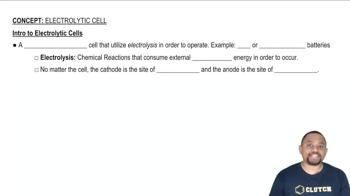
The Electrolytic Cell

Inert Electrodes

Inert electrodes, such as platinum or graphite, do not participate in the chemical reactions occurring during electrolysis. Their primary function is to conduct electricity and facilitate the transfer of electrons to the ions in the electrolyte. This allows the electrochemical reactions to occur without the electrode material being consumed or altered.
Video consigliato:
Percorso guidato
04:44
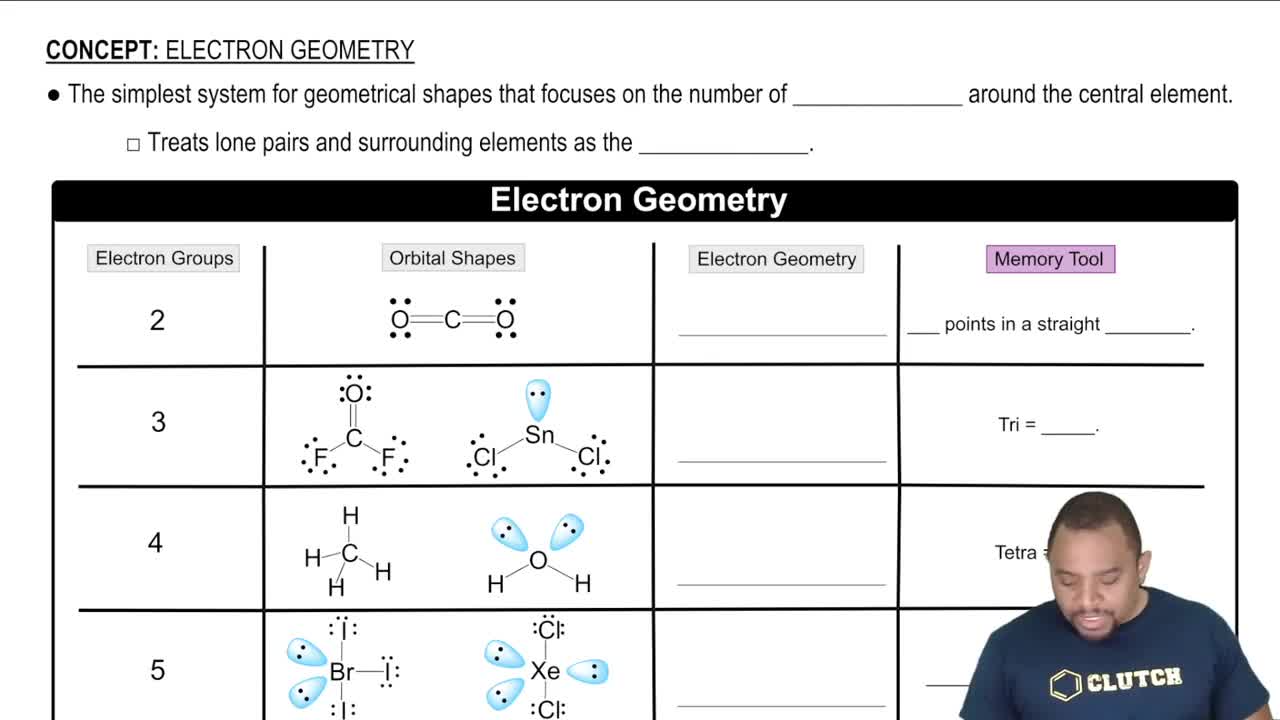
Electron Geometry

Ion and Electron Flow

During electrolysis, ions move towards the electrodes of opposite charge: cations (positive ions) migrate to the cathode (negative electrode) to gain electrons, while anions (negative ions) move to the anode (positive electrode) to lose electrons. This flow of ions and electrons is essential for the electrochemical reactions that lead to the production of elements or compounds from the electrolyte.
Video consigliato:
Percorso guidato
00:35
Anion Electron Configuration
Pratica correlata
Domanda del libro di testo

Classify each of the following unbalanced half-reactions as either an oxidation or a reduction. (b) Pt2+ (aq) → Pt(s)

430
views

Domanda del libro di testo

How are standard reduction potentials defined?

121
views
Domanda del libro di testo

Porous pellets of TiO2 can be reduced to titanium metal at the cathode of an electrochemical cell containing molten CaCl2 as the electrolyte. When the TiO2 is reduced, the O2-ions dis-solve in the CaCl2 and are subsequently oxidized to O2 gas at the anode. This approach may be the basis for a less expensive process than the one currently used for producing titanium.

(c) Write balanced equations for the anode, cathode, and overall cell reactions.

618
views
Domanda del libro di testo
Consider a Daniell cell with 1.0 M ion concentrations:

Does the cell voltage increase, decrease, or remain the same when each of the following changes is made? Explain. (a) Write a balanced equation for each cell reaction.
1009
views
Domanda del libro di testo

Calculate the standard cell potential and the standard free-energy change (in kilojoules) for the reaction below. (See Appendix D for standard reduction potentials.) <QUESTION REFERENCES APPENDIX D>

107
views
Domanda del libro di testo

Porous pellets of TiO2 can be reduced to titanium metal at the cathode of an electrochemical cell containing molten CaCl2 as the electrolyte. When the TiO2 is reduced, the O2-ions dis-solve in the CaCl2 and are subsequently oxidized to O2 gas at the anode. This approach may be the basis for a less expensive process than the one currently used for producing titanium.

(a) Label the anode and cathode, and indicate the signs of the electrodes.

365
views