Ch.19 - Electrochemistry
McMurry - Chemistry 8th Edition
McMurry8th EditionChemistryISBN: 9781292336145Non è quello che usi tu?Cambia libro di testo
Capitolo 19, Problema 19.88

Calculate the standard cell potential and the standard free-energy change (in kilojoules) for the reaction below. (See Appendix D for standard reduction potentials.) <QUESTION REFERENCES APPENDIX D>

Guida verificata passo dopo passo
1
Identify the half-reactions involved in the overall reaction and write their standard reduction potentials from Appendix D.
Determine which half-reaction will undergo oxidation and which will undergo reduction by comparing their standard reduction potentials.
Calculate the standard cell potential (E°_cell) using the formula: E°_cell = E°_cathode - E°_anode.
Use the Nernst equation to relate the standard cell potential to the standard free-energy change: ΔG° = -nFE°_cell, where n is the number of moles of electrons transferred and F is the Faraday constant (96,485 C/mol).
Convert the standard free-energy change from joules to kilojoules by dividing by 1,000.

Risposta video verificata per un problema simile:

Questa soluzione video è stata consigliata dai nostri tutor come utile per risolvere questo problema.
Durata del video:
6m

Concetti chiave

Ecco i concetti essenziali che devi comprendere per rispondere correttamente alla domanda.

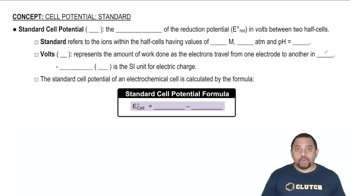
Standard Cell Potential

The standard cell potential (E°) is the measure of the voltage produced by an electrochemical cell under standard conditions (1 M concentration, 1 atm pressure, and 25°C). It is calculated using the standard reduction potentials of the half-reactions involved in the cell. A positive E° indicates a spontaneous reaction, while a negative E° suggests non-spontaneity.
Video consigliato:
Percorso guidato
01:27
Standard Cell Potential

Standard Free Energy Change

The standard free energy change (ΔG°) quantifies the spontaneity of a reaction at standard conditions. It is related to the standard cell potential by the equation ΔG° = -nFE°, where n is the number of moles of electrons transferred and F is Faraday's constant (approximately 96485 C/mol). A negative ΔG° indicates that the reaction is spontaneous.
Video consigliato:
Percorso guidato
00:32
Standard Gibbs Free Energy and Temperature

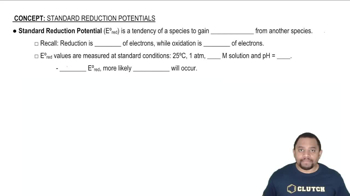
Half-Reactions and Reduction Potentials

Half-reactions represent the oxidation or reduction processes occurring in an electrochemical cell. Each half-reaction has an associated standard reduction potential, which indicates the tendency of a species to gain electrons. By combining the half-reactions and their potentials, one can determine the overall cell potential and the direction of electron flow in the cell.
Video consigliato:
Percorso guidato
01:10
Standard Reduction Potentials