Ch.19 - Electrochemistry
McMurry - Chemistry 8th Edition
McMurry8th EditionChemistryISBN: 9781292336145Non è quello che usi tu?Cambia libro di testo
Capitolo 19, Problema 37

Consider a Daniell cell with 1.0 M ion concentrations: Diagram of a Daniell cell showing zinc and copper electrodes with a voltmeter.
Does the cell voltage increase, decrease, or remain the same when each of the following changes is made? Explain. (a) Write a balanced equation for each cell reaction.

Guida verificata passo dopo passo
1
Identify the half-reactions occurring at the anode and cathode. The anode is where oxidation occurs, and the cathode is where reduction occurs.
Write the oxidation half-reaction at the anode: Zn(s) → Zn²⁺(aq) + 2e⁻.
Write the reduction half-reaction at the cathode: Cu²⁺(aq) + 2e⁻ → Cu(s).
Combine the half-reactions to write the overall balanced cell reaction: Zn(s) + Cu²⁺(aq) → Zn²⁺(aq) + Cu(s).
Analyze how changes in ion concentrations or other conditions would affect the cell voltage based on the Nernst equation.

Risposta video verificata per un problema simile:

Questa soluzione video è stata consigliata dai nostri tutor come utile per risolvere questo problema.
Durata del video:
5m

Concetti chiave

Ecco i concetti essenziali che devi comprendere per rispondere correttamente alla domanda.

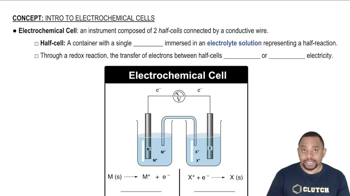
Electrochemical Cells

Electrochemical cells, such as the Daniell cell, convert chemical energy into electrical energy through redox reactions. In a Daniell cell, zinc acts as the anode where oxidation occurs, while copper acts as the cathode where reduction takes place. The flow of electrons from the anode to the cathode generates an electric current, which can be measured as voltage.
Video consigliato:
Percorso guidato
02:46
Electrochemical Cells

Half-Reactions

Half-reactions represent the individual oxidation and reduction processes occurring in an electrochemical cell. For the Daniell cell, the oxidation half-reaction involves zinc losing electrons to form zinc ions (Zn → Zn²⁺ + 2e⁻), while the reduction half-reaction involves copper ions gaining electrons to form solid copper (Cu²⁺ + 2e⁻ → Cu). Balancing these half-reactions is essential for understanding the overall cell reaction.
Video consigliato:
Percorso guidato
01:49
First-Order Half-Life

Nernst Equation

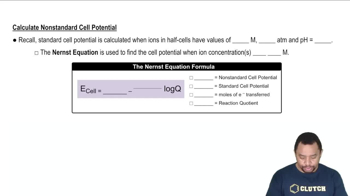
The Nernst equation relates the cell potential to the concentrations of the reactants and products in an electrochemical reaction. It shows how changes in ion concentration affect the voltage of the cell. For a Daniell cell, increasing the concentration of reactants (like Zn²⁺ or Cu²⁺) can lead to an increase in cell voltage, while decreasing their concentrations can lower the voltage, illustrating the dynamic nature of electrochemical systems.
Video consigliato:
Percorso guidato
01:17
The Nernst Equation
Pratica correlata
Domanda del libro di testo
Sketch a cell with inert electrodes suitable for electrolysis of aqueous CuBr2. (b) Indicate the direction of electron and ion flow.
659
views

Domanda del libro di testo

How are standard reduction potentials defined?

121
views
Domanda del libro di testo

The silver oxide–zinc battery used in watches delivers a voltage of 1.60 V. Calculate the free-energy change (in kilo-joules) for the cell reaction

113
views
Domanda del libro di testo

Porous pellets of TiO2 can be reduced to titanium metal at the cathode of an electrochemical cell containing molten CaCl2 as the electrolyte. When the TiO2 is reduced, the O2-ions dis-solve in the CaCl2 and are subsequently oxidized to O2 gas at the anode. This approach may be the basis for a less expensive process than the one currently used for producing titanium.

(c) Write balanced equations for the anode, cathode, and overall cell reactions.

618
views
Domanda del libro di testo

Calculate the standard cell potential and the standard free-energy change (in kilojoules) for the reaction below. (See Appendix D for standard reduction potentials.) <QUESTION REFERENCES APPENDIX D>

107
views
Domanda del libro di testo

Porous pellets of TiO2 can be reduced to titanium metal at the cathode of an electrochemical cell containing molten CaCl2 as the electrolyte. When the TiO2 is reduced, the O2-ions dis-solve in the CaCl2 and are subsequently oxidized to O2 gas at the anode. This approach may be the basis for a less expensive process than the one currently used for producing titanium.

(a) Label the anode and cathode, and indicate the signs of the electrodes.

365
views