Ch.21 - Transition Elements and Coordination Chemistry
McMurry - Chemistry 8th Edition
McMurry8th EditionChemistryISBN: 9781292336145Non è quello che usi tu?Cambia libro di testo
Capitolo 21, Problema 21.2

Based on effective nuclear charge (Zeff), which ion is the strongest oxidizing agent? 
(a) Cu2+
(b) Ni2+
(c) Fe2+
(d) Mn2+

Guida verificata passo dopo passo
1
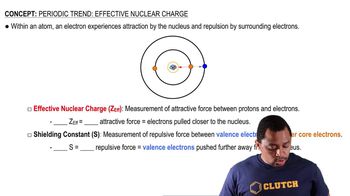
Understand that the effective nuclear charge (Z_eff) is the net positive charge experienced by an electron in a multi-electron atom. It is calculated as Z_eff = Z - S, where Z is the atomic number and S is the shielding constant.
Recognize that a higher Z_eff means the electrons are held more tightly by the nucleus, which can influence the oxidizing ability of an ion.
Consider that a strong oxidizing agent is one that readily gains electrons, which is facilitated by a higher Z_eff as it indicates a stronger attraction for electrons.
Compare the Z_eff for each ion: Cu^{2+}, Ni^{2+}, Fe^{2+}, and Mn^{2+}. Calculate or estimate Z_eff for each based on their atomic numbers and typical shielding values.
Determine which ion has the highest Z_eff, as this ion will be the strongest oxidizing agent due to its greater ability to attract and gain electrons.

Risposta video verificata per un problema simile:

Questa soluzione video è stata consigliata dai nostri tutor come utile per risolvere questo problema.

Concetti chiave

Ecco i concetti essenziali che devi comprendere per rispondere correttamente alla domanda.

Effective Nuclear Charge (Z_eff)

Effective nuclear charge (Z_eff) refers to the net positive charge experienced by an electron in a multi-electron atom. It accounts for the shielding effect of inner electrons, which reduces the full nuclear charge felt by outer electrons. A higher Z_eff indicates a stronger attraction between the nucleus and the outer electrons, influencing the atom's reactivity and ability to act as an oxidizing agent.
Video consigliato:
Percorso guidato
01:51
Effective Nuclear Charge

Oxidizing Agent

An oxidizing agent is a substance that gains electrons in a chemical reaction, causing another substance to be oxidized. The strength of an oxidizing agent is often related to its ability to attract electrons, which is influenced by its effective nuclear charge. Stronger oxidizing agents have a greater tendency to accept electrons, making them more reactive in redox reactions.
Video consigliato:
Percorso guidato
01:01
Oxidizing and Reducing Agents

Transition Metals and Oxidation States

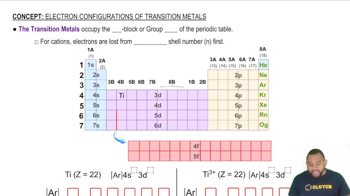
Transition metals can exhibit multiple oxidation states, which significantly affects their chemical behavior, including their role as oxidizing agents. The oxidation state of a transition metal ion can influence its Z_eff and, consequently, its ability to accept electrons. Understanding the common oxidation states of metals like Cu, Ni, Fe, and Mn is crucial for predicting their reactivity and identifying the strongest oxidizing agent among them.
Video consigliato:
Percorso guidato
03:12
Transition Metals