Ch.21 - Transition Elements and Coordination Chemistry
McMurry - Chemistry 8th Edition
McMurry8th EditionChemistryISBN: 9781292336145Non è quello che usi tu?Cambia libro di testo
Capitolo 21, Problema 21.9

What is the crystal field energy level diagram for the complex [Fe(NH3)6]3+?
(a)
(b)
(c)
(d)

Guida verificata passo dopo passo
1
Identify the oxidation state and electron configuration of the metal ion. In this case, Fe in [Fe(NH3)6]3+ is in the +3 oxidation state. The electron configuration of Fe3+ is 3d5.
Determine the geometry of the complex. Ammonia (NH3) is a neutral ligand and typically forms octahedral complexes with transition metals. Thus, [Fe(NH3)6]3+ is an octahedral complex.
Understand the splitting of d-orbitals in an octahedral field. In an octahedral complex, the d-orbitals split into two groups due to the ligand field: t2g (lower energy) and eg (higher energy).
Distribute the electrons of Fe3+ in the split d-orbitals. Since Fe3+ has 5 electrons, these will occupy the t2g orbitals first (according to Hund's rule and the Pauli exclusion principle), resulting in three electrons in t2g and two remaining in t2g.
Sketch the crystal field energy level diagram based on the above information. The diagram should show the t2g orbitals fully occupied by five electrons and the eg orbitals empty, reflecting the electron configuration and energy levels in an octahedral field.

Risposta video verificata per un problema simile:

Questa soluzione video è stata consigliata dai nostri tutor come utile per risolvere questo problema.

Concetti chiave

Ecco i concetti essenziali che devi comprendere per rispondere correttamente alla domanda.

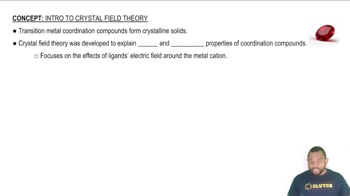
Crystal Field Theory

Crystal Field Theory (CFT) explains the electronic structure of transition metal complexes by considering the effect of surrounding ligands on the d-orbitals of the metal ion. It describes how the degeneracy of d-orbitals is lifted due to the electrostatic interactions between the metal ion and the ligands, leading to different energy levels for the d-electrons.
Video consigliato:
Percorso guidato
01:18
The study of ligand-metal interactions helped to form Ligand Field Theory which combines CFT with MO Theory.

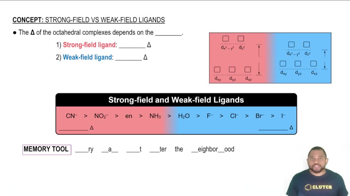
Ligand Field Splitting

In a complex like [Fe(NH3)6]3+, the arrangement of ligands around the metal ion causes the d-orbitals to split into different energy levels. For octahedral complexes, the d-orbitals split into two sets: the lower-energy t2g orbitals and the higher-energy eg orbitals. The extent of this splitting is influenced by the nature of the ligands and the oxidation state of the metal.
Video consigliato:
Percorso guidato
02:40
Strong-Field Ligands result in a large Δ and Weak-Field Ligands result in a small Δ.

High Spin vs. Low Spin Complexes

High spin and low spin configurations refer to the arrangement of electrons in the d-orbitals of transition metal complexes. High spin complexes have unpaired electrons in higher energy orbitals, resulting from weak field ligands, while low spin complexes have paired electrons in lower energy orbitals due to strong field ligands. The spin state affects the magnetic properties and stability of the complex.
Video consigliato:
Percorso guidato
01:28
For octahedral complexes, Weak-Field Ligands create High-spin complexes and Strong-Field Ligands create Low-spin complexes.