Ch.21 - Transition Elements and Coordination Chemistry
McMurry - Chemistry 8th Edition
McMurry8th EditionChemistryISBN: 9781292336145Non è quello che usi tu?Cambia libro di testo
Capitolo 21, Problema 21.47

What is the general trend in standard potentials for the oxidation of first-series transition metals from Sc to Zn? What is the reason for the trend?

Guida verificata passo dopo passo
1
Identify the first-series transition metals, which range from Scandium (Sc) to Zinc (Zn) in the periodic table.
Understand that standard reduction potentials are used to determine the tendency of a species to be reduced; the more positive the potential, the greater the species' tendency to gain electrons.
Recognize that the standard oxidation potential is the negative of the standard reduction potential. Therefore, a more negative reduction potential indicates a greater tendency for oxidation.
Observe the general trend in standard reduction potentials for these metals: they become more positive as you move from Sc to Zn, indicating a decreasing tendency to be oxidized.
Explain the trend: The increasing nuclear charge across the period results in a stronger attraction between the nucleus and the electrons, making it harder for the metals to lose electrons and thus decreasing their tendency to be oxidized.

Risposta video verificata per un problema simile:

Questa soluzione video è stata consigliata dai nostri tutor come utile per risolvere questo problema.

Concetti chiave

Ecco i concetti essenziali che devi comprendere per rispondere correttamente alla domanda.

Standard Electrode Potential

Standard electrode potential is a measure of the tendency of a chemical species to be reduced, expressed in volts. It is determined under standard conditions and is crucial for predicting the direction of redox reactions. Higher standard potentials indicate a greater likelihood of reduction, while lower potentials suggest a greater tendency for oxidation.
Video consigliato:
Percorso guidato
01:27
Standard Cell Potential

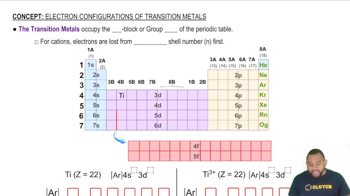
First-Series Transition Metals

The first-series transition metals, which include elements from scandium (Sc) to zinc (Zn), are characterized by the filling of the 3d subshell. These metals exhibit variable oxidation states and complex ion formation, influencing their chemical behavior and standard electrode potentials. Understanding their electron configurations helps explain trends in their reactivity and potential values.
Video consigliato:
Percorso guidato
03:12
Transition Metals

Trends in Oxidation Potentials

The trend in oxidation potentials for first-series transition metals generally shows a decrease from Sc to Zn. This trend can be attributed to the increasing nuclear charge and effective nuclear charge experienced by the d-electrons, which stabilizes the oxidation states. As the atomic number increases, the ability of the metal to lose electrons diminishes, leading to lower oxidation potentials.
Video consigliato:
Percorso guidato
00:58
Oxide Reactions