Ch.21 - Transition Elements and Coordination Chemistry
McMurry - Chemistry 8th Edition
McMurry8th EditionChemistryISBN: 9781292336145Non è quello che usi tu?Cambia libro di testo
Capitolo 21, Problema 21.140b

Cobalt(III) trifluoroacetylacetonate, Co(tfac)3, is a sixcoordinate, octahedral metal chelate in which three planar, bidentate tfac ligands are attached to a central Co atom:
(b) Diastereoisomers A and B have dipole moments of 6.5 D and 3.8 D, respectively. Which of your diastereoisomers is A and which is B?

Guida verificata passo dopo passo
1
Identify the structure of the octahedral complex Co(tfac)_3, where tfac is a bidentate ligand, meaning each tfac ligand forms two bonds with the central Co atom.
Understand that diastereoisomers are stereoisomers that are not mirror images of each other, and in octahedral complexes, they can arise from different spatial arrangements of the ligands.
Consider the possible arrangements of the three tfac ligands around the cobalt center. In an octahedral complex, these can lead to different spatial configurations, such as facial (fac) and meridional (mer) isomers.
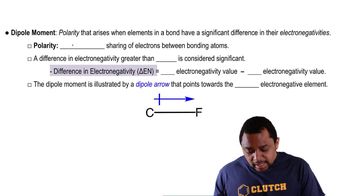
Recall that the dipole moment is a measure of the separation of positive and negative charges in a molecule. A higher dipole moment indicates a more polar molecule, which can be influenced by the spatial arrangement of the ligands.
Assign the diastereoisomers based on their dipole moments: the isomer with the higher dipole moment (6.5 D) is likely to have a less symmetrical arrangement of ligands, while the isomer with the lower dipole moment (3.8 D) is likely to have a more symmetrical arrangement.

Risposta video verificata per un problema simile:

Questa soluzione video è stata consigliata dai nostri tutor come utile per risolvere questo problema.

Concetti chiave

Ecco i concetti essenziali che devi comprendere per rispondere correttamente alla domanda.

Diastereoisomers

Diastereoisomers are a type of stereoisomer that are not mirror images of each other. They occur in compounds with multiple chiral centers, where the configuration at one or more centers differs while others remain the same. This results in distinct physical properties, such as different dipole moments, which can be used to differentiate between them.

Dipole Moment

The dipole moment is a measure of the separation of positive and negative charges in a molecule, indicating its polarity. It is a vector quantity, with both magnitude and direction, and is expressed in Debye units (D). A higher dipole moment generally suggests a more polar molecule, which can influence its interactions and stability.
Video consigliato:

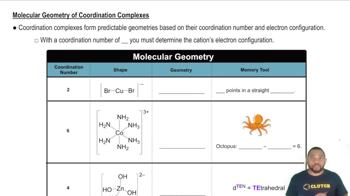
Octahedral Coordination

Octahedral coordination refers to a molecular geometry where a central atom is surrounded by six ligands at the corners of an octahedron. This arrangement is common in transition metal complexes, such as cobalt(III) trifluoroacetylacetonate, and affects the electronic and steric properties of the complex, influencing its reactivity and interactions with other molecules.
Video consigliato:
Percorso guidato
02:40
Molecular Geometry of Coordination Complexes