
Ch.21 - Transition Elements and Coordination Chemistry
McMurry - Chemistry 8th Edition
McMurry8th EditionChemistryISBN: 9781292336145Non è quello che usi tu?Cambia libro di testo
Capitolo 21, Problema 21.38b

Predict the number of unpaired electrons for each of the following.
(c) Mn3+
(d) Cr2+

Guida verificata passo dopo passo
1
Step 1: Determine the electron configuration of the neutral atom. For Mn (Manganese), the electron configuration is [Ar] 4s2 3d5. For Cr (Chromium), the electron configuration is [Ar] 4s1 3d5.
Step 2: Remove electrons to account for the positive charge. For Mn3+, remove three electrons. The first two electrons are removed from the 4s orbital, and the third electron is removed from the 3d orbital, resulting in the electron configuration [Ar] 3d4. For Cr2+, remove two electrons. The first electron is removed from the 4s orbital, and the second electron is removed from the 3d orbital, resulting in the electron configuration [Ar] 3d4.
Step 3: Determine the number of unpaired electrons by looking at the electron configuration. For Mn3+, there are four unpaired electrons in the 3d orbital. For Cr2+, there are also four unpaired electrons in the 3d orbital.
Step 4: Remember that unpaired electrons are responsible for the magnetic properties of an atom or ion. The more unpaired electrons, the stronger the magnetic properties.
Step 5: Practice predicting the number of unpaired electrons for different atoms and ions to become more comfortable with this process.

Risposta video verificata per un problema simile:

Questa soluzione video è stata consigliata dai nostri tutor come utile per risolvere questo problema.
Durata del video:
3m

Concetti chiave

Ecco i concetti essenziali che devi comprendere per rispondere correttamente alla domanda.

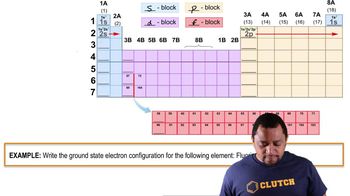
Electron Configuration

Electron configuration describes the distribution of electrons in an atom's orbitals. For transition metals, this involves filling the 3d and 4s orbitals according to the Aufbau principle, Hund's rule, and the Pauli exclusion principle. Understanding the electron configuration of an element is crucial for predicting its chemical properties, including the number of unpaired electrons.
Video consigliato:
Percorso guidato
01:33
Electron Configuration Example

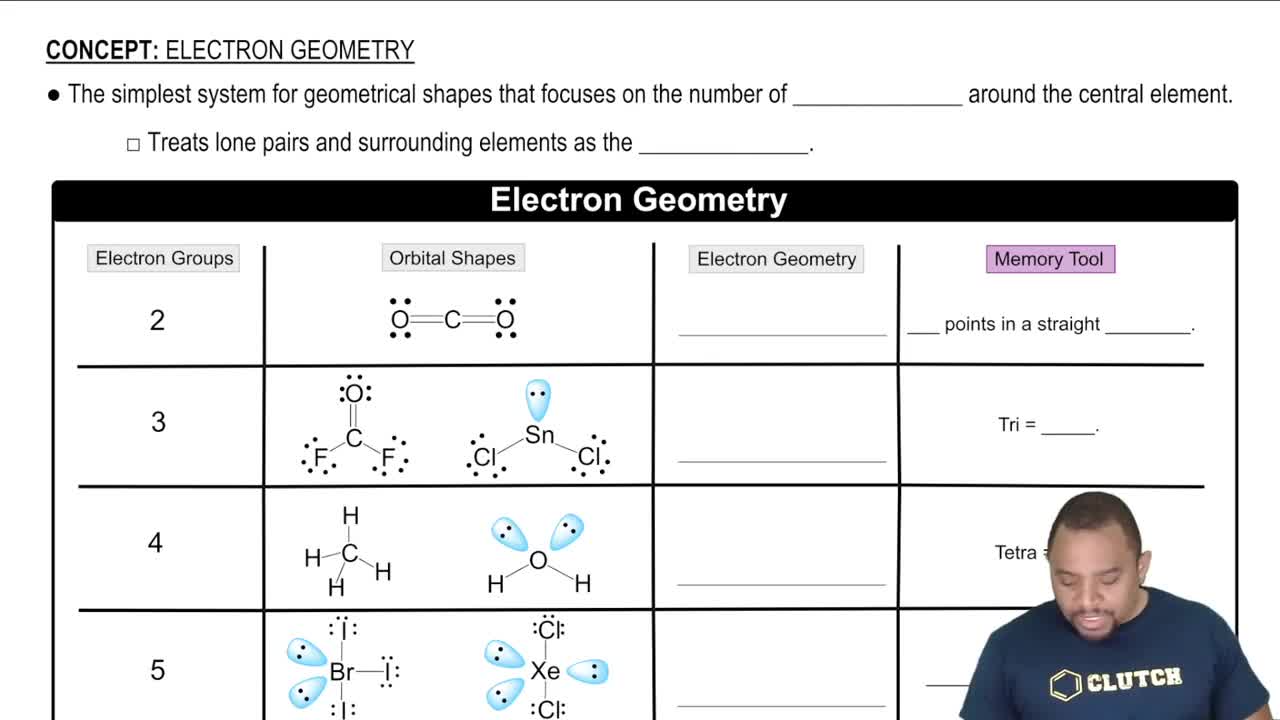
Unpaired Electrons

Unpaired electrons are electrons that occupy an orbital alone rather than in pairs. The presence of unpaired electrons in an atom contributes to its magnetic properties and reactivity. In transition metals, the number of unpaired electrons can be determined by examining the electron configuration and identifying how many electrons are in the d orbitals without a partner.
Video consigliato:
Percorso guidato
04:44
Electron Geometry

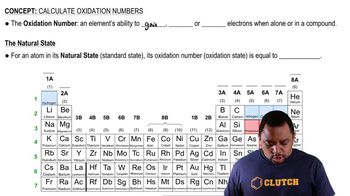
Oxidation States

Oxidation states indicate the degree of oxidation of an atom in a compound, reflecting the number of electrons lost or gained. For transition metals, oxidation states can affect the electron configuration significantly. For example, Mn in Mn3+ has lost three electrons, which alters its electron configuration and the number of unpaired electrons compared to its neutral state.
Video consigliato:
Percorso guidato
02:42
Oxidation Numbers
Pratica correlata
Domanda del libro di testo

For each of the following complexes, describe the bonding using valence bond theory. Include orbital diagrams for the free metal ion and the metal ion in the complex. Indicate which hybrid orbitals the metal ion uses for bonding, and specify the number of unpaired electrons. 

(b) [Ag(NH3)2]+

128
views
Domanda del libro di testo

For each of the following complexes, draw a crystal field energy-level diagram, assign the electrons to orbitals, and predict the number of unpaired electrons.

(b) [MnCl4]2- (tetrahedral)

107
views
Domanda del libro di testo

Cobalt(III) trifluoroacetylacetonate, Co(tfac)3, is a sixcoordinate, octahedral metal chelate in which three planar, bidentate tfac ligands are attached to a central Co atom:

(b) Diastereoisomers A and B have dipole moments of 6.5 D and 3.8 D, respectively. Which of your diastereoisomers is A and which is B?

108
views
Domanda del libro di testo

Assign a systematic name to each of the following ions.

(c) [Fe(H2O)5NCS]2+

(d) [Cr(NH3)2(C2O4)2]-

221
views
Domanda del libro di testo

Tell how many diastereoisomers are possible for each of the following complexes, and draw their structures. 

(c) [Cu(H2O)4Cl2]+

(d) Ru(NH3)3I3

89
views
Domanda del libro di testo

Give a valence bond description of the bonding in each of the following complexes. Include orbital diagrams for the free metal ion and the metal ion in the complex. Indicate which hybrid orbitals the metal ion uses for bonding, and specify the number of unpaired electrons. 

(b) [NiBr4]2- (tetrahedral) 

112
views