
Ch.21 - Transition Elements and Coordination Chemistry
McMurry - Chemistry 8th Edition
McMurry8th EditionChemistryISBN: 9781292336145Non è quello che usi tu?Cambia libro di testo
Capitolo 21, Problema 7

Identify the false statement about the structures of the complex ion [Fe(en)2Cl2]+ shown below.
(a) Structures I and II are cis-trans isomers.
(b) Structures I and IV are cis-trans isomers.
(c) Structures I and III are enantiomers.
(d) Structures II and IV are enantiomers.

Guida verificata passo dopo passo
1
Identify the ligand arrangement around the central metal ion in each structure to determine the type of isomerism or stereochemistry.
Understand the concept of cis-trans isomerism: cis isomers have similar groups on the same side, while trans isomers have them on opposite sides.
Recognize enantiomers as non-superimposable mirror images, typically involving chiral centers.
Compare structures I and II, and I and IV to check if similar groups are on the same or opposite sides to verify if they are cis-trans isomers.
Compare structures I and III, and II and IV to determine if they are mirror images of each other, which would indicate they are enantiomers.

Risposta video verificata per un problema simile:

Questa soluzione video è stata consigliata dai nostri tutor come utile per risolvere questo problema.

Concetti chiave

Ecco i concetti essenziali che devi comprendere per rispondere correttamente alla domanda.

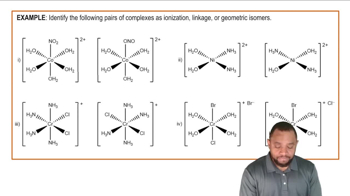
Cis-Trans Isomerism

Cis-trans isomerism occurs in coordination compounds where ligands can occupy different spatial arrangements around a central metal ion. In a cis configuration, similar ligands are adjacent to each other, while in a trans configuration, they are opposite. This concept is crucial for understanding the geometric differences in the structures of complex ions.
Video consigliato:
Percorso guidato
3:33
Isomerism in Coordination Complexes Example

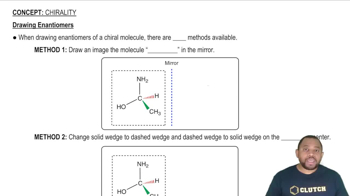
Enantiomers

Enantiomers are a type of stereoisomer that are non-superimposable mirror images of each other. They typically arise in chiral environments, such as when a metal ion is coordinated to ligands in a way that creates asymmetry. Recognizing enantiomers is essential for determining the optical activity and specific interactions of complex ions.
Video consigliato:
Percorso guidato
02:33
Drawing Enantiomers

Coordination Chemistry

Coordination chemistry studies the structures and properties of complex ions formed by metal ions and surrounding ligands. The arrangement of ligands around the metal can lead to various geometric configurations, influencing the chemical behavior and reactivity of the complex. Understanding coordination chemistry is fundamental for analyzing the relationships between different structural forms of complex ions.
Video consigliato:
Percorso guidato
00:27
Coordination Numbers