
Ch.21 - Transition Elements and Coordination Chemistry
McMurry - Chemistry 8th Edition
McMurry8th EditionChemistryISBN: 9781292336145Non è quello che usi tu?Cambia libro di testo
Capitolo 21, Problema 5

Refer to the figure showing the structure of various ligands to answer questions 4 and 5. Which ligand(s) can participate in linkage isomerism?
(a) All of the ligands can participate in linkage isomerism
(b) I, II, and III
(c) I and IV
(d) II and IV

Guida verificata passo dopo passo
1
Understand the concept of linkage isomerism: Linkage isomerism occurs when a ligand can bind to a metal center through different atoms.
Identify ligands that can exhibit linkage isomerism: Look for ligands with more than one potential donor atom.
Examine the structure of each ligand: Determine if each ligand has multiple atoms that can coordinate to the metal center.
Compare the ligands: Identify which ligands have the ability to bind through different atoms, thus exhibiting linkage isomerism.
Select the correct option: Based on your analysis, choose the option that lists the ligands capable of linkage isomerism.

Risposta video verificata per un problema simile:

Questa soluzione video è stata consigliata dai nostri tutor come utile per risolvere questo problema.

Concetti chiave

Ecco i concetti essenziali che devi comprendere per rispondere correttamente alla domanda.

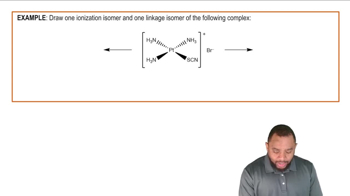
Linkage Isomerism

Linkage isomerism occurs when a ligand can coordinate to a metal center in more than one way, leading to different structural isomers. This phenomenon is common in coordination compounds where ligands have multiple donor atoms, allowing them to form bonds with the metal in different orientations. Understanding which ligands can exhibit this behavior is crucial for answering questions about their structural variations.
Video consigliato:
Percorso guidato
2:14
Isomerism in Coordination Complexes Example

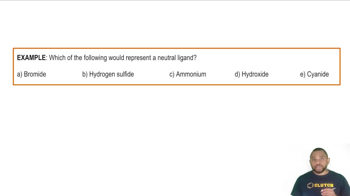
Ligands

Ligands are ions or molecules that can donate a pair of electrons to a central metal atom to form a coordination complex. They can be classified based on the number of donor atoms they possess, such as monodentate (one donor atom) or polydentate (multiple donor atoms). The nature of the ligands significantly influences the properties and reactivity of the coordination compounds they form.
Video consigliato:
Percorso guidato
01:12
Ligands Example

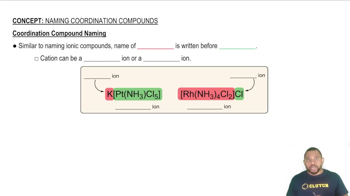
Coordination Compounds

Coordination compounds consist of a central metal atom bonded to surrounding ligands. The arrangement and type of ligands can affect the geometry, stability, and reactivity of the complex. Analyzing the structure of these compounds is essential for understanding their chemical behavior, including phenomena like linkage isomerism.
Video consigliato:
Percorso guidato
01:32
Coordination Compound Naming