
Ch.21 - Transition Elements and Coordination Chemistry
McMurry - Chemistry 8th Edition
McMurry8th EditionChemistryISBN: 9781292336145Non è quello che usi tu?Cambia libro di testo
Capitolo 21, Problema 26b

Locate on the periodic table the transition elements with the following electron configurations. Identify each element.
(c) [Kr] 4d25s2
(d) [Xe] 4f36s2

Guida verificata passo dopo passo
1
Identify the core electron configuration: For (c), the core is [Kr], and for (d), the core is [Xe].
Determine the additional electrons: For (c), add 4d^2 5s^2, and for (d), add 4f^3 6s^2.
Locate the period: For (c), the 5s and 4d orbitals indicate the 5th period. For (d), the 6s and 4f orbitals indicate the 6th period.
Identify the block: Both configurations involve d and f orbitals, indicating transition metals.
Find the element: For (c), locate the element with 2 electrons in the 4d subshell in the 5th period. For (d), locate the element with 3 electrons in the 4f subshell in the 6th period.

Risposta video verificata per un problema simile:

Questa soluzione video è stata consigliata dai nostri tutor come utile per risolvere questo problema.

Concetti chiave

Ecco i concetti essenziali che devi comprendere per rispondere correttamente alla domanda.

Electron Configuration

Electron configuration describes the distribution of electrons in an atom's orbitals. It is represented using a notation that indicates the energy levels and sublevels occupied by electrons. Understanding electron configurations is crucial for identifying elements, especially transition metals, as they often involve partially filled d and f orbitals.
Video consigliato:
Percorso guidato
01:33
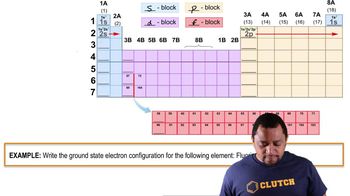
Electron Configuration Example

Transition Elements

Transition elements, or transition metals, are found in groups 3 to 12 of the periodic table. They are characterized by their ability to form variable oxidation states and complex ions, and they typically have partially filled d orbitals. This unique electron configuration contributes to their distinctive chemical properties, such as catalytic activity and the formation of colored compounds.
Video consigliato:
Percorso guidato
03:30
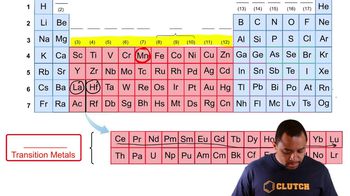
Transition Metals and Representative Elements

Periodic Table Positioning

The periodic table organizes elements based on their atomic number and electron configurations, which reflect their chemical properties. Transition metals are located in the central block of the table, and their positions can be determined by their electron configurations. Identifying an element based on its electron configuration requires knowledge of the periodic table's layout and the specific groups associated with transition metals.
Video consigliato:
Percorso guidato
02:40
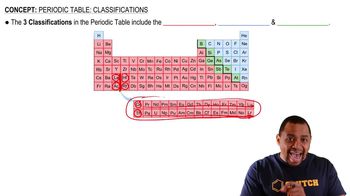
Periodic Table Classifications
Pratica correlata
Domanda del libro di testo

What is the systematic name for each of the following molecules or ions? Include cis or trans prefixes for diastereoisomers. Platinum is Pt(II) in square planar complexes and Pt(IV) in octahedral complexes.

(1)

(2)

(3)

(4)

71
views
Domanda del libro di testo

Locate on the periodic table the transition elements with the following electron configurations. Identify each element.

(a) [Ar] 3d74s2

(b) [Ar] 3d54s1

98
views
Domanda del libro di testo

The complete reaction of 2.60 g of chromium metal with 50.00 mL of 1.200 M H2SO4 in the absence of air gave a blue solution and a colorless gas that was collected at 25°C and a pressure of 735 mm Hg. (e) When an excess of KCN is added to the solution, the color changes, and the paramagnetism of the solution

decreases. Explain.

103
views
Domanda del libro di testo

In acidic aqueous solution, the complex trans-[Co(en)2Cl1]2+(aq) undergoes the following substitution reaction:

trans-[Co(en)2Cl1]+(aq) + H2O(l) → trans-[Co(en)2(H2O)Cl]2+(aq) + Cl–(aq)

The reaction is first order in trans-[Co(en)2Cl2]+(aq), and the rate constant at 25°C is 3.2×10⁻⁵ s–1.

e. Draw a crystal field energy-level diagram for trans-[Co(en)2Cl2]+ that takes account of the fact that Cl– is a weaker-field ligand than ethylenediamine.

82
views
Domanda del libro di testo

Look at the location in the periodic table of elements A, B, C, and D. What is the electron configuration of the transition metal in each of the following ions?

(c) C3+

(d) DO42-

104
views
Domanda del libro di testo

Consider the following isomers [Cr(NH3)2Cl4]-.

(a) Label the isomers as cis or trans.

(b) Which isomers are identical, and which are different?

(c) Do any of these isomers exist as enantiomers? Explain.

103
views