Ch.21 - Transition Elements and Coordination Chemistry
McMurry - Chemistry 8th Edition
McMurry8th EditionChemistryISBN: 9781292336145Non è quello che usi tu?Cambia libro di testo
Capitolo 21, Problema 40

Titanium, used to make jet aircraft engines, is much harder than potassium or calcium. Explain.

Guida verificata passo dopo passo
1
Step 1: Understand that the hardness of a metal is determined by the strength of the bonds between its atoms. The stronger the bonds, the harder the metal.
Step 2: Recognize that titanium, potassium, and calcium are all metals, but they belong to different groups on the periodic table. Titanium is a transition metal, while potassium and calcium are alkali and alkaline earth metals, respectively.
Step 3: Recall that transition metals like titanium typically form stronger metallic bonds than alkali and alkaline earth metals. This is because transition metals have more delocalized electrons available for bonding, leading to a stronger 'sea of electrons' that holds the metal atoms together.
Step 4: Understand that the 'sea of electrons' model explains why metals are malleable and ductile. In this model, the metal atoms are surrounded by a 'sea' of delocalized electrons, which allows the atoms to slide past each other without breaking the metallic bonds.
Step 5: Conclude that because titanium forms stronger metallic bonds than potassium or calcium, it is harder than these metals.

Risposta video verificata per un problema simile:

Questa soluzione video è stata consigliata dai nostri tutor come utile per risolvere questo problema.

Concetti chiave

Ecco i concetti essenziali che devi comprendere per rispondere correttamente alla domanda.

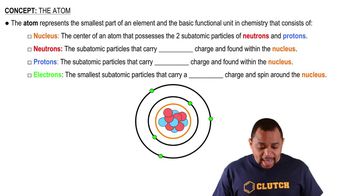
Atomic Structure and Bonding

The hardness of a material is largely determined by its atomic structure and the type of bonding present. Titanium has a strong metallic bond due to its closely packed crystal structure, which allows for effective sharing of electrons. In contrast, potassium and calcium have weaker metallic bonds and larger atomic radii, leading to less hardness.
Video consigliato:

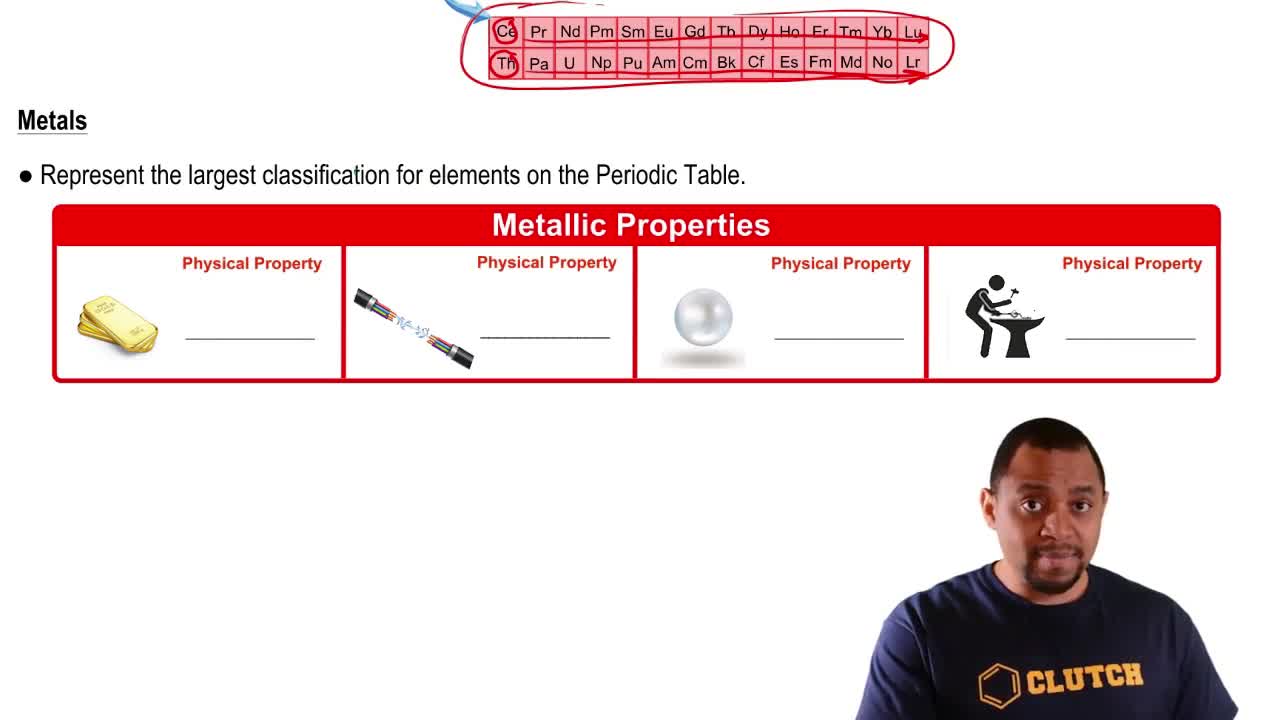
Metallic Properties

Metals exhibit a range of properties, including hardness, ductility, and conductivity, which are influenced by their atomic arrangement and bonding. Titanium, being a transition metal, has a higher density of valence electrons that contribute to its strength and hardness compared to alkali metals like potassium and alkaline earth metals like calcium, which are softer due to their single valence electron.
Video consigliato:
Percorso guidato
02:05
Metal Properties

Crystal Lattice Structure

The arrangement of atoms in a crystal lattice significantly affects a material's hardness. Titanium forms a hexagonal close-packed structure, which is more efficient in packing atoms tightly together, enhancing its hardness. In contrast, potassium and calcium have body-centered cubic structures that do not provide the same level of atomic packing and strength.
Video consigliato: