Ch.21 - Transition Elements and Coordination Chemistry
McMurry - Chemistry 8th Edition
McMurry8th EditionChemistryISBN: 9781292336145Non è quello che usi tu?Cambia libro di testo
Capitolo 21, Problema 43

Arrange the following atoms in order of decreasing atomic radius, and account for the trend.
(a) Cr
(b) Ti
(c) Mn
(d) V

Guida verificata passo dopo passo
1
Identify the position of each element in the periodic table. Chromium (Cr), Titanium (Ti), Manganese (Mn), and Vanadium (V) are all transition metals located in the same period (Period 4) of the periodic table.
Recall that within a period, atomic radius generally decreases from left to right. This is due to the increase in the number of protons in the nucleus, which increases the nuclear charge and pulls the electron cloud closer to the nucleus.
Locate the group numbers for each element to determine their order in the periodic table. Ti is in Group 4, V in Group 5, Cr in Group 6, and Mn in Group 7.
Based on the trend of decreasing atomic radius from left to right in a period, arrange the elements in order of decreasing atomic radius starting from the element located furthest left in the periodic table to the one furthest right.
The order of decreasing atomic radius from the elements given will be: Titanium (Ti), Vanadium (V), Chromium (Cr), Manganese (Mn).

Risposta video verificata per un problema simile:

Questa soluzione video è stata consigliata dai nostri tutor come utile per risolvere questo problema.

Concetti chiave

Ecco i concetti essenziali che devi comprendere per rispondere correttamente alla domanda.

Atomic Radius

Atomic radius is defined as the distance from the nucleus of an atom to the outermost shell of electrons. It generally increases down a group in the periodic table due to the addition of electron shells, while it decreases across a period from left to right due to increased nuclear charge, which pulls electrons closer to the nucleus.
Video consigliato:

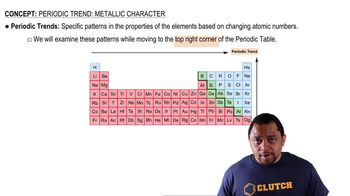
Periodic Trends

Periodic trends refer to predictable patterns observed in the properties of elements as you move across or down the periodic table. For atomic radius, the trend shows that elements in the same group have larger radii than those in the same period, influenced by factors such as electron shielding and effective nuclear charge.
Video consigliato:
Percorso guidato
00:38
Periodic Trends

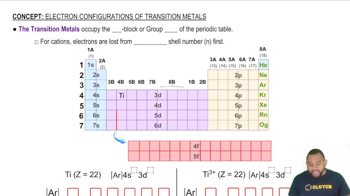
Transition Metals

Transition metals, such as Cr, Ti, Mn, and V, exhibit unique properties due to their partially filled d-orbitals. Their atomic radii can be influenced by the presence of d-electrons, which can affect electron shielding and the overall size of the atom, making the comparison of their radii slightly more complex than for main group elements.
Video consigliato:
Percorso guidato
03:12
Transition Metals