Ch.21 - Transition Elements and Coordination Chemistry
McMurry - Chemistry 8th Edition
McMurry8th EditionChemistryISBN: 9781292336145Non è quello che usi tu?Cambia libro di testo
Capitolo 21, Problema 41

Molybdenum (mp 2623 °C) has a higher melting point than yttrium (mp 1522 °C) or cadmium (mp 321 °C). Explain.

Guida verificata passo dopo passo
1
1. The melting point of a substance is determined by the strength of the forces between its atoms. The stronger these forces, the more energy is required to break them and melt the substance.
2. Molybdenum, yttrium, and cadmium are all metals. In metals, the atoms are held together by metallic bonds, which involve a 'sea' of delocalized electrons moving freely around a lattice of positive ions.
3. The strength of the metallic bond depends on the number of delocalized electrons and the size of the positive ions. More delocalized electrons and smaller ions lead to stronger bonds and higher melting points.
4. Molybdenum has more delocalized electrons than yttrium or cadmium, due to its higher atomic number. This means it has stronger metallic bonds and a higher melting point.
5. Additionally, molybdenum's ions are smaller than those of yttrium or cadmium, which also contributes to its stronger metallic bonds and higher melting point.

Risposta video verificata per un problema simile:

Questa soluzione video è stata consigliata dai nostri tutor come utile per risolvere questo problema.

Concetti chiave

Ecco i concetti essenziali che devi comprendere per rispondere correttamente alla domanda.

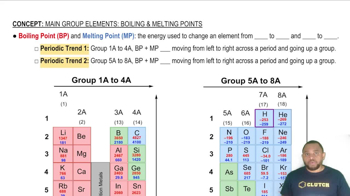
Melting Point

The melting point is the temperature at which a solid becomes a liquid. It is influenced by the strength of the bonds between atoms or molecules in a substance. Higher melting points typically indicate stronger intermolecular or metallic bonds, which require more energy to break.
Video consigliato:
Percorso guidato
04:29
Boiling Point and Melting Point

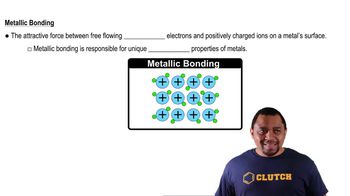
Metallic Bonding

Metallic bonding occurs in metals where electrons are shared among a lattice of positively charged ions. This 'sea of electrons' allows for high electrical conductivity and contributes to the strength of the metallic bond, which is a key factor in determining the melting point of metals like molybdenum.
Video consigliato:

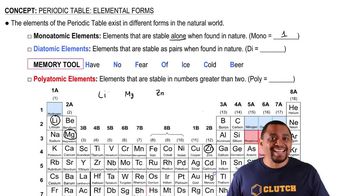
Elemental Properties

Different elements exhibit varying physical and chemical properties based on their atomic structure and electron configuration. Transition metals, such as molybdenum, often have higher melting points due to their ability to form strong metallic bonds and their larger atomic size, which allows for more effective packing in the solid state.
Video consigliato:
Percorso guidato
02:35
Elemental Forms of Elements