Ch.21 - Transition Elements and Coordination Chemistry
McMurry - Chemistry 8th Edition
McMurry8th EditionChemistryISBN: 9781292336145Non è quello che usi tu?Cambia libro di testo
Capitolo 21, Problema 44

What is the lanthanide contraction, and why does it occur?

Guida verificata passo dopo passo
1
The lanthanide contraction refers to the gradual decrease in the atomic and ionic radii of the lanthanide series elements from lanthanum (La) to lutetium (Lu).
This contraction occurs as you move across the series from element to element. Despite the increasing atomic number, the additional electrons are added to the 4f subshell, which is poorly shielding the outer electrons from the charge of the nucleus.
The poor shielding effect of the 4f electrons is due to their shape and the fact that they are buried beneath the 5s and 5p shells. This allows the effective nuclear charge (the net positive charge experienced by electrons in the outermost shell) to increase.
As the effective nuclear charge increases, it pulls the electrons closer to the nucleus, leading to a decrease in the size of the atom or ion.
The lanthanide contraction has significant effects on the chemical and physical properties of the elements and their compounds, including increased hardness, higher melting and boiling points, and greater densities.

Risposta video verificata per un problema simile:

Questa soluzione video è stata consigliata dai nostri tutor come utile per risolvere questo problema.

Concetti chiave

Ecco i concetti essenziali che devi comprendere per rispondere correttamente alla domanda.

Lanthanide Series

The lanthanide series consists of 15 elements from lanthanum (La) to lutetium (Lu) in the periodic table. These elements are known for their similar properties and are often referred to as rare earth elements. They are characterized by the filling of the 4f subshell, which plays a crucial role in their chemical behavior and physical properties.
Video consigliato:
Percorso guidato
02:02
Activity Series Chart

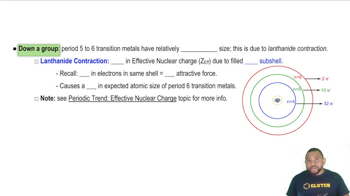
Lanthanide Contraction

Lanthanide contraction refers to the gradual decrease in the ionic and atomic radii of the lanthanide elements as the atomic number increases. This phenomenon occurs due to the poor shielding effect of the 4f electrons, which leads to a stronger effective nuclear charge felt by the outer electrons. As a result, the elements become more compact despite the addition of more electrons.
Video consigliato:
Percorso guidato
02:30
Lanthanide Contraction

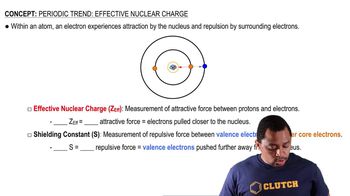
Effective Nuclear Charge

Effective nuclear charge (Z_eff) is the net positive charge experienced by an electron in a multi-electron atom. It accounts for the actual nuclear charge minus the shielding effect of inner-shell electrons. In the context of the lanthanides, the increase in Z_eff as one moves across the series contributes to the lanthanide contraction, as the outer electrons are pulled closer to the nucleus, reducing atomic size.
Video consigliato:
Percorso guidato
01:51
Effective Nuclear Charge