
Ch.22 - The Main Group Elements
McMurry - Chemistry 8th Edition
McMurry8th EditionChemistryISBN: 9781292336145Non è quello che usi tu?Cambia libro di testo
Capitolo 22, Problema 24

In the following pictures of oxides, red spheres represent O atoms or ions, and green spheres represent atoms or ions of a second- or third-row element in its highest oxidation state.
(1)
(2)
(3)
(b) Identify each oxide as ionic or covalent.

Guida verificata passo dopo passo
1
Identify the element represented by the green spheres in each picture by considering it is a second- or third-row element in its highest oxidation state.
Determine the oxidation state of the green sphere element by analyzing the stoichiometry and charge balance in the compound.
Examine the electronegativity difference between the oxygen atoms (red spheres) and the element represented by the green spheres. A large difference typically indicates an ionic bond, while a smaller difference suggests a covalent bond.
Consider the lattice structure and arrangement of the atoms or ions in the pictures if available, as ionic compounds generally form crystalline structures, whereas covalent compounds might form molecular structures.
Classify each oxide as ionic or covalent based on the above analyses.

Risposta video verificata per un problema simile:

Questa soluzione video è stata consigliata dai nostri tutor come utile per risolvere questo problema.

Concetti chiave

Ecco i concetti essenziali che devi comprendere per rispondere correttamente alla domanda.

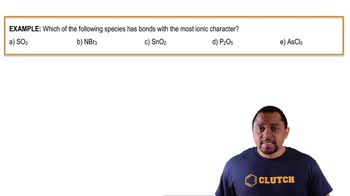
Ionic vs. Covalent Bonds

Ionic bonds form between metals and nonmetals when electrons are transferred, resulting in charged ions that attract each other. In contrast, covalent bonds occur when two nonmetals share electrons, leading to the formation of molecules. Understanding the nature of the elements involved helps determine whether an oxide is ionic or covalent.
Video consigliato:
Percorso guidato
01:16
Chemical Bonds Example 1

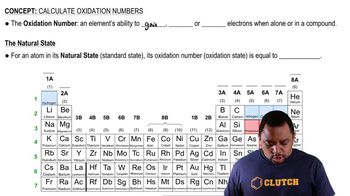
Oxidation States

The oxidation state of an element indicates its degree of oxidation or reduction in a compound. In oxides, the oxidation state of oxygen is typically -2, while the oxidation state of the other element can vary. Identifying these states is crucial for determining the type of bonding present in the oxide.
Video consigliato:
Percorso guidato
02:42
Oxidation Numbers

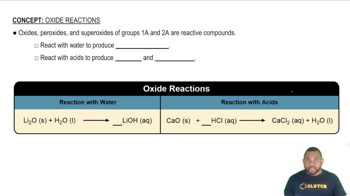
Structure of Oxides

The structure of oxides can provide insights into their bonding characteristics. Ionic oxides tend to form crystalline lattices, while covalent oxides may exist as discrete molecules or network solids. Analyzing the arrangement of atoms or ions in the provided pictures can help classify each oxide as ionic or covalent.
Video consigliato:
Percorso guidato
00:58
Oxide Reactions