Ch.22 - The Main Group Elements
McMurry - Chemistry 8th Edition
McMurry8th EditionChemistryISBN: 9781292336145Non è quello che usi tu?Cambia libro di testo
Capitolo 22, Problema 22.86

Describe the structure of diborane (B2H6) and explain why the bridging B–H bonds are longer than the terminal B–H bonds.

Guida verificata passo dopo passo
1
Diborane (B_2H_6) consists of two boron (B) atoms and six hydrogen (H) atoms. The structure is unique due to the presence of bridging hydrogen atoms.
In diborane, there are four terminal hydrogen atoms, each bonded to a boron atom, and two bridging hydrogen atoms that form bonds between the two boron atoms.
The terminal B–H bonds are typical covalent bonds, where each hydrogen shares a pair of electrons with a boron atom.
The bridging B–H bonds are different; they are three-center two-electron (3c-2e) bonds, involving two boron atoms and one hydrogen atom sharing two electrons.
The bridging B–H bonds are longer than the terminal B–H bonds because the electron density is spread over three atoms in the 3c-2e bonds, resulting in weaker and longer bonds compared to the typical two-center two-electron bonds of the terminal B–H.

Risposta video verificata per un problema simile:

Questa soluzione video è stata consigliata dai nostri tutor come utile per risolvere questo problema.

Concetti chiave

Ecco i concetti essenziali che devi comprendere per rispondere correttamente alla domanda.

Diborane Structure

Diborane (B2H6) has a unique structure characterized by two boron atoms and six hydrogen atoms. It features a central framework where two boron atoms are connected by two bridging hydrogen atoms, forming a 'banana bond' geometry. This arrangement leads to a three-dimensional shape that is not typical for simple covalent compounds, making diborane a fascinating example of electron-deficient bonding.
Video consigliato:
Percorso guidato
01:42
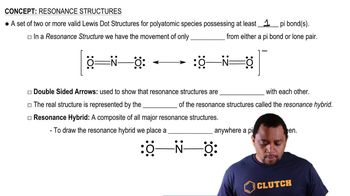
Resonance Structures

Terminal vs. Bridging Bonds

In diborane, terminal B–H bonds are formed between a boron atom and a hydrogen atom directly attached to it, while bridging B–H bonds connect two boron atoms through a hydrogen atom. The terminal bonds are shorter due to the direct overlap of orbitals between boron and hydrogen, resulting in stronger, more stable bonds compared to the bridging bonds, which involve more complex orbital interactions.
Video consigliato:

Bond Length and Strength

Bond length is influenced by the strength of the bond; stronger bonds tend to be shorter. In diborane, the terminal B–H bonds are stronger and thus shorter than the bridging B–H bonds. The bridging bonds are longer because they involve a different bonding interaction, where the hydrogen atom is shared between two boron atoms, leading to a weaker bond due to less effective orbital overlap.
Video consigliato:
Percorso guidato
00:36
Average Bond Order