Ch.22 - The Main Group Elements
McMurry - Chemistry 8th Edition
McMurry8th EditionChemistryISBN: 9781292336145Non è quello che usi tu?Cambia libro di testo
Capitolo 22, Problema 22.113

Compare and contrast the properties of ammonia and phosphine.

Guida verificata passo dopo passo
1
Identify the chemical formulas for ammonia and phosphine: Ammonia is NH₃ and phosphine is PH₃.
Compare the molecular geometry: Both ammonia and phosphine have a trigonal pyramidal shape due to the presence of a lone pair on the nitrogen and phosphorus atoms, respectively.
Discuss the polarity: Ammonia is polar due to the difference in electronegativity between nitrogen and hydrogen, while phosphine is less polar because the electronegativity difference between phosphorus and hydrogen is smaller.
Examine the hydrogen bonding: Ammonia can form hydrogen bonds due to the presence of highly electronegative nitrogen, whereas phosphine cannot form hydrogen bonds as effectively because phosphorus is less electronegative.
Compare the boiling points: Ammonia has a higher boiling point than phosphine due to the presence of hydrogen bonding, which requires more energy to break compared to the weaker van der Waals forces in phosphine.

Risposta video verificata per un problema simile:

Questa soluzione video è stata consigliata dai nostri tutor come utile per risolvere questo problema.

Concetti chiave

Ecco i concetti essenziali che devi comprendere per rispondere correttamente alla domanda.

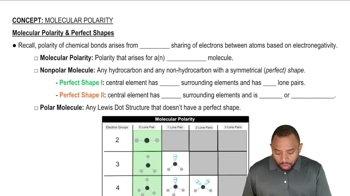
Molecular Structure and Polarity

Ammonia (NH3) and phosphine (PH3) have distinct molecular structures that influence their properties. Ammonia has a trigonal pyramidal shape due to the presence of a lone pair on nitrogen, making it polar and capable of hydrogen bonding. In contrast, phosphine has a similar structure but is less polar due to phosphorus's larger size and lower electronegativity, resulting in weaker intermolecular forces.
Video consigliato:
Percorso guidato
02:38
Molecular Polarity

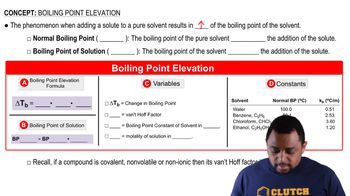
Boiling Points and Volatility

The boiling points of ammonia and phosphine differ significantly due to their molecular interactions. Ammonia has a higher boiling point (−33.34 °C) because of strong hydrogen bonds, while phosphine has a lower boiling point (−87.7 °C) due to weaker van der Waals forces. This difference in boiling points reflects their volatility and stability as gases at room temperature.
Video consigliato:
Percorso guidato
03:05
Boiling Point Elevation

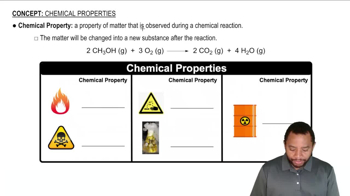
Reactivity and Chemical Behavior

Ammonia and phosphine exhibit different reactivities due to their molecular characteristics. Ammonia is a strong base and can readily donate a proton, participating in various acid-base reactions. Phosphine, on the other hand, is less basic and more stable, making it less reactive under similar conditions. This difference affects their roles in chemical reactions and their applications in various fields.
Video consigliato:
Percorso guidato
03:31
Chemical Properties