Draw the electron-dot structure for CO, CO2, and CO32–, and predict which substance will have the strongest carbon–oxygen bond.
Ch.22 - The Main Group Elements
Capitolo 22, Problema 22.3
Which of the following elements (X) will form a covalent hydride with the formula XH3 that is a gas at room temperature? (LO 22.4)
(a) Al (b) As (c) Ba (d) Se
Guida verificata passo dopo passo1
Identify the elements that can form covalent bonds with hydrogen to create a hydride.
Consider the periodic table position of each element: Al, As, Ba, and Se.
Recall that covalent hydrides are typically formed by nonmetals or metalloids.
Determine which of the given elements is likely to form a gaseous hydride at room temperature.
Recognize that As (arsenic) is a metalloid that can form a covalent hydride, AsH_3, which is a gas at room temperature.

Risposta video verificata per un problema simile:
Questa soluzione video è stata consigliata dai nostri tutor come utile per risolvere questo problema.
Concetti chiave
Ecco i concetti essenziali che devi comprendere per rispondere correttamente alla domanda.
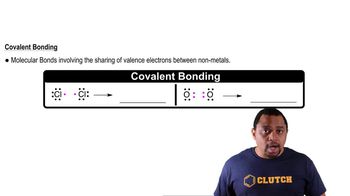
Covalent Bonding
Covalent bonding occurs when two atoms share one or more pairs of electrons, typically between nonmetals. This type of bond results in the formation of molecules, such as hydrides, where the hydrogen atom bonds with another element. Understanding the nature of covalent bonds is essential for predicting the properties of compounds, including their state at room temperature.
Video consigliato:
Percorso guidato
Chemical Bonds
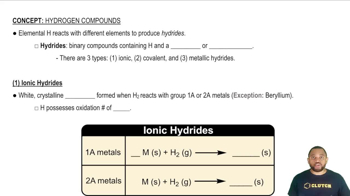
Hydrides
Hydrides are compounds formed between hydrogen and another element. They can be classified into ionic and covalent hydrides, with covalent hydrides being formed by nonmetals. The physical state of hydrides at room temperature can vary; for instance, covalent hydrides of lighter nonmetals tend to be gases, while those of heavier elements may be liquids or solids.
Video consigliato:
Percorso guidato
Ionic Hydrides
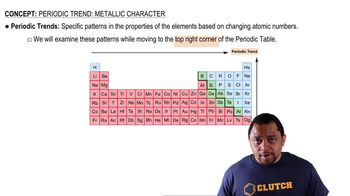
Periodic Trends
Periodic trends refer to the predictable patterns in the properties of elements as you move across or down the periodic table. These trends influence factors such as electronegativity, atomic size, and the ability to form covalent bonds. Recognizing these trends helps in determining which elements are likely to form gaseous hydrides, as lighter elements in specific groups tend to form such compounds.
Video consigliato:
Percorso guidato
Periodic Trends
Pratica correlata
Domanda del libro di testo
89
views
Domanda del libro di testo
Compare and contrast the properties of ammonia and phosphine.
101
views
Domanda del libro di testo
What is the hybridization and geometry around carbon atoms in graphene? Explain why graphene is an excellent conductor of electricity.
118
views
Domanda del libro di testo
Describe the structure of diborane (B2H6) and explain why the bridging B–H bonds are longer than the terminal B–H bonds.
82
views
Domanda del libro di testo
Using the shorthand notation of Figure 22.9, draw the structure of the cyclic silicate anion in which four SiO4 tetrahedra share O atoms to form an eight-membered ring of alternating Si and O atoms. Give the formula and charge of the anion.
120
views
Domanda del libro di testo
Give an example of an ionic carbide. What is the oxidation state of carbon in this substance?
84
views