Ch.5 - Periodicity & Electronic Structure of Atoms
McMurry - Chemistry 8th Edition
McMurry8th EditionChemistryISBN: 9781292336145Non è quello che usi tu?Cambia libro di testo
Capitolo 5, Problema 113

Assuming that g orbitals fill according to Hund's rule, what is the atomic number of the first element to have a filled g orbital?

Guida verificata passo dopo passo
1
Step 1: Understand that the atomic number of an element corresponds to the number of protons in the nucleus of an atom, which also equals the number of electrons in a neutral atom. The arrangement of these electrons in various energy levels and sublevels is described by the electron configuration.
Step 2: Recall that the electron configuration of an atom is determined by the Aufbau principle, Pauli exclusion principle, and Hund's rule. The Aufbau principle states that electrons fill the lowest energy levels first. The Pauli exclusion principle states that each orbital can hold a maximum of two electrons with opposite spins. Hund's rule states that electrons will fill degenerate (equal energy) orbitals singly before pairing up.
Step 3: Remember that the order of filling of the orbitals is as follows: 1s, 2s, 2p, 3s, 3p, 4s, 3d, 4p, 5s, 4d, 5p, 6s, 4f, 5d, 6p, 7s, 5f, 6d, 7p, 8s, 5g. This order is determined by the (n+l) rule, where n is the principal quantum number and l is the azimuthal quantum number.
Step 4: From the order of filling, we can see that the g orbitals (l=4) start filling after the 7p orbitals. The 7p orbitals can hold a maximum of 6 electrons, so the g orbitals start filling at atomic number 119.
Step 5: However, to have a filled g orbital, we need to add 18 more electrons (as a g subshell can hold a maximum of 18 electrons). Therefore, the first element to have a filled g orbital would be the element with atomic number 119 + 18 = 137.

Risposta video verificata per un problema simile:

Questa soluzione video è stata consigliata dai nostri tutor come utile per risolvere questo problema.
Durata del video:
4m

Concetti chiave

Ecco i concetti essenziali che devi comprendere per rispondere correttamente alla domanda.

Hund's Rule

Hund's Rule states that electrons will fill degenerate orbitals (orbitals of the same energy) singly before pairing up. This minimizes electron-electron repulsion and stabilizes the atom. In the context of g orbitals, this means that each of the five g orbitals will be filled with one electron before any of them receives a second electron.
Video consigliato:
Percorso guidato
00:28
Solubility Rules

Electron Configuration

Electron configuration describes the distribution of electrons in an atom's orbitals. For g orbitals, which can hold up to 14 electrons, the filling follows the order dictated by the Aufbau principle, which states that electrons occupy the lowest energy orbitals first. Understanding the sequence of filling helps identify when g orbitals become fully occupied.
Video consigliato:
Percorso guidato
01:33
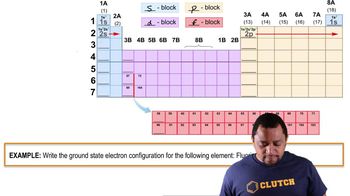
Electron Configuration Example

Atomic Number and Periodic Table

The atomic number of an element corresponds to the number of protons in its nucleus and determines its position in the periodic table. As elements are arranged by increasing atomic number, the filling of orbitals, including g orbitals, can be tracked. The first element with a filled g orbital is found in the actinide series, specifically element 103, Lawrencium (Lr).
Video consigliato:
Percorso guidato
04:01
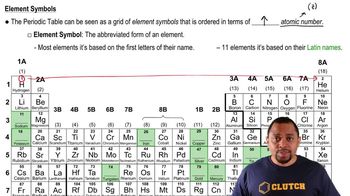
Periodic Table History