Ch.5 - Periodicity & Electronic Structure of Atoms
McMurry - Chemistry 8th Edition
McMurry8th EditionChemistryISBN: 9781292336145Non è quello che usi tu?Cambia libro di testo
Capitolo 5, Problema 111f

Given the subshells 1s, 2s, 2p, 3s, 3p and 3d, identify those that meet the following descriptions. (f) Can contain two electrons, both with spin ms = +1/2

Guida verificata passo dopo passo
1
Step 1: Understand the concept of electron spin. The spin quantum number, ms, can have two possible values: +1/2 and -1/2. These represent the two possible spin states of an electron in an atomic orbital.
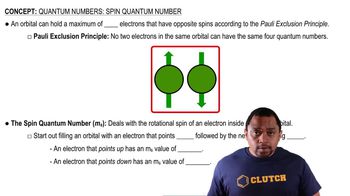
Step 2: Remember that each atomic orbital can contain a maximum of two electrons. These two electrons must have opposite spins, meaning one electron has a spin of +1/2 and the other has a spin of -1/2. This is known as the Pauli Exclusion Principle.
Step 3: Based on the Pauli Exclusion Principle, no atomic orbital can contain two electrons both with spin ms = +1/2. Therefore, none of the given subshells (1s, 2s, 2p, 3s, 3p, 3d) can contain two electrons both with spin ms = +1/2.
Step 4: If the question is asking for a situation where two electrons in the same subshell have the same spin, this is possible. For example, in the 2p subshell, there are three orbitals. One electron with spin +1/2 could be in one orbital, and another electron with spin +1/2 could be in a different orbital within the same subshell.
Step 5: However, if the question is asking for two electrons with the same spin in the same orbital, this is not possible due to the Pauli Exclusion Principle.

Risposta video verificata per un problema simile:

Questa soluzione video è stata consigliata dai nostri tutor come utile per risolvere questo problema.
Durata del video:
6m

Concetti chiave

Ecco i concetti essenziali che devi comprendere per rispondere correttamente alla domanda.

Electron Configuration

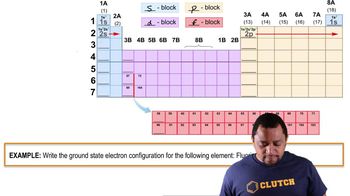
Electron configuration describes the distribution of electrons in an atom's orbitals. Each subshell can hold a specific number of electrons: s subshells can hold 2, p can hold 6, and d can hold 10. Understanding how electrons fill these subshells according to the Aufbau principle is essential for identifying which subshells can accommodate specific electron spins.
Video consigliato:
Percorso guidato
01:33
Electron Configuration Example

Pauli Exclusion Principle

The Pauli Exclusion Principle states that no two electrons in an atom can have the same set of four quantum numbers. This principle implies that within a given orbital, such as an s subshell, only two electrons can exist, and they must have opposite spins. This concept is crucial for determining how many electrons can occupy a subshell and their respective spins.
Video consigliato:
Percorso guidato
02:05
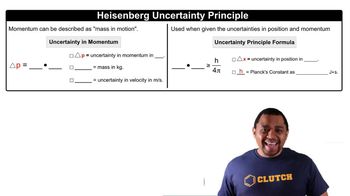
Uncertainty Principle Formula

Spin Quantum Number

The spin quantum number (m_s) describes the intrinsic angular momentum of an electron, which can be either +1/2 or -1/2. This property is significant in determining how electrons pair up in orbitals. In the context of the question, identifying subshells that can contain two electrons with the same spin (+1/2) is essential for understanding electron pairing and subshell occupancy.
Video consigliato:
Percorso guidato
01:18
Spin Quantum Number