Ch.5 - Periodicity & Electronic Structure of Atoms
McMurry - Chemistry 8th Edition
McMurry8th EditionChemistryISBN: 9781292336145Non è quello che usi tu?Cambia libro di testo
Capitolo 5, Problema 115

Cyclooctatetraene dianion, C8H8 2-, is an organic ion with the structure shown. Considering only the p bonds and not the s bonds, cyclooctatetraene dianion can be described by the following energy diagrams of its p molecular orbitals: Energy diagram of p molecular orbitals for cyclooctatetraene dianion, C8H8 2-.
(d) Based on your MO energy diagram, is the dianion paramagnetic or diamagnetic?

Guida verificata passo dopo passo
1
Identify the number of π electrons in the cyclooctatetraene dianion (C8H8 2-). Each double bond contributes 2 π electrons, and there are 4 double bonds, so there are 8 π electrons.
Determine the number of molecular orbitals (MOs) available for these π electrons. For cyclooctatetraene, there are 8 π molecular orbitals.
Fill the π molecular orbitals with the 8 π electrons, starting from the lowest energy level and following Hund's rule and the Pauli exclusion principle.
Check the electron configuration in the molecular orbitals. If all electrons are paired, the molecule is diamagnetic. If there are unpaired electrons, the molecule is paramagnetic.
Based on the provided MO energy diagram, observe the electron filling and determine if there are any unpaired electrons to conclude if the dianion is paramagnetic or diamagnetic.

Risposta video verificata per un problema simile:

Questa soluzione video è stata consigliata dai nostri tutor come utile per risolvere questo problema.
Durata del video:
2m

Concetti chiave

Ecco i concetti essenziali che devi comprendere per rispondere correttamente alla domanda.

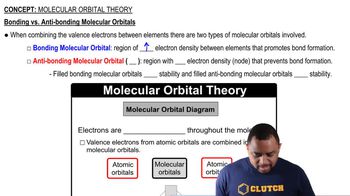
Molecular Orbitals (MOs)

Molecular orbitals are formed by the combination of atomic orbitals when atoms bond together. In the case of cyclooctatetraene dianion, the p orbitals combine to form bonding and antibonding molecular orbitals. The arrangement and occupancy of these MOs determine the electronic properties of the molecule, including its magnetic behavior.
Video consigliato:
Percorso guidato
03:06
Molecular Orbital Theory

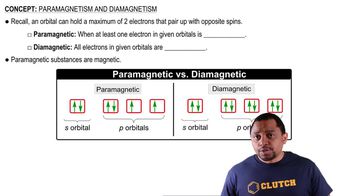
Paramagnetism vs. Diamagnetism

Paramagnetism occurs in species that have unpaired electrons, leading to a net magnetic moment that can align with an external magnetic field. In contrast, diamagnetism is exhibited by species with all electrons paired, resulting in no net magnetic moment. The presence of unpaired electrons in the molecular orbitals of cyclooctatetraene dianion will dictate whether it is paramagnetic or diamagnetic.
Video consigliato:
Percorso guidato
01:33
Paramagnetism vs Diamagnetism

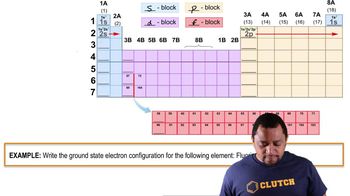
Electron Configuration in MOs

The electron configuration in molecular orbitals is crucial for determining the magnetic properties of a molecule. Electrons fill the molecular orbitals starting from the lowest energy level, following the Pauli exclusion principle and Hund's rule. By analyzing the filling of the p molecular orbitals in cyclooctatetraene dianion, one can ascertain whether there are unpaired electrons, which would indicate paramagnetism.
Video consigliato:
Percorso guidato
01:33
Electron Configuration Example