
Ch.5 - Periodicity & Electronic Structure of Atoms
McMurry - Chemistry 8th Edition
McMurry8th EditionChemistryISBN: 9781292336145Non è quello che usi tu?Cambia libro di testo
Capitolo 5, Problema 124

Orbital energies in single-electron atoms or ions, such as He+, can be described with an equation similar to the Balmer–Rydberg equation: Diagram illustrating the Bohr model for electron transitions in He+.
where Z is the atomic number. What wavelength of light in nanometers is emitted when the electron in He+ falls from n = 3 to n = 2?

Guida verificata passo dopo passo
1
Identify the given values: Z = 2 (for He+), n1 = 2, and n2 = 3.
Use the Rydberg formula for hydrogen-like atoms: \( \frac{1}{\lambda} = RZ^2 \left( \frac{1}{n_1^2} - \frac{1}{n_2^2} \right) \), where R is the Rydberg constant (1.097 x 10^7 m^-1).
Substitute the given values into the Rydberg formula: \( \frac{1}{\lambda} = 1.097 \times 10^7 \times 2^2 \left( \frac{1}{2^2} - \frac{1}{3^2} \right) \).
Simplify the expression inside the parentheses: \( \frac{1}{4} - \frac{1}{9} \).
Calculate the value of \( \frac{1}{\lambda} \) and then take the reciprocal to find the wavelength \( \lambda \) in meters. Convert the result to nanometers by multiplying by 10^9.

Risposta video verificata per un problema simile:

Questa soluzione video è stata consigliata dai nostri tutor come utile per risolvere questo problema.
Durata del video:
1m

Concetti chiave

Ecco i concetti essenziali che devi comprendere per rispondere correttamente alla domanda.

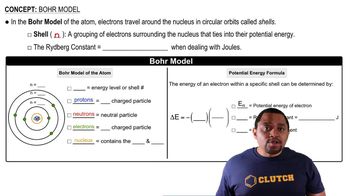
Bohr Model of the Atom

The Bohr model describes the behavior of electrons in atoms, particularly hydrogen-like atoms, where electrons occupy quantized energy levels. In this model, an electron can transition between these levels, emitting or absorbing energy in the form of light. The energy difference between levels determines the wavelength of the emitted or absorbed light.
Video consigliato:
Percorso guidato
02:43
Bohr Model of the Atom

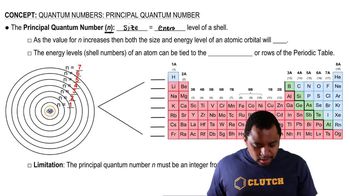
Energy Levels and Quantum Numbers

Energy levels in an atom are defined by quantum numbers, with 'n' representing the principal quantum number. Each level corresponds to a specific energy state, and transitions between these levels result in the emission or absorption of photons. For He+, the energy levels can be calculated using the formula E_n = -Z² * 13.6 eV/n², where Z is the atomic number.
Video consigliato:
Percorso guidato
02:55
Principal Quantum Number

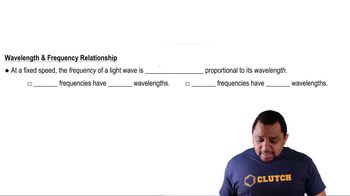
Wavelength and Frequency Relationship

The wavelength of light emitted during an electron transition is inversely related to its frequency, as described by the equation c = λν, where c is the speed of light, λ is the wavelength, and ν is the frequency. The energy of the emitted photon can also be calculated using E = hν, where h is Planck's constant. This relationship is crucial for determining the wavelength of light emitted during electron transitions.
Video consigliato:
Percorso guidato
00:31
Frequency-Wavelength Relationship