Why do atomic radii decrease from left to right across a period of the periodic table?
Ch.5 - Periodicity & Electronic Structure of Atoms
Tutti i libri di testo
McMurry 8th Edition
Ch.5 - Periodicity & Electronic Structure of Atoms
Problema 122
McMurry 8th Edition
Ch.5 - Periodicity & Electronic Structure of Atoms
Problema 122Capitolo 5, Problema 122
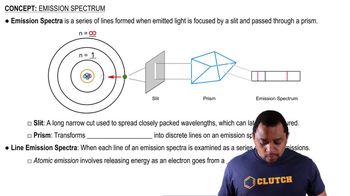
Why do the Earth and Sun have different emission spectra?
Guida verificata passo dopo passo1
Understand that emission spectra are produced when atoms or molecules emit light at specific wavelengths as electrons transition between energy levels.
Recognize that the Earth and the Sun are composed of different elements and compounds, which means they have different sets of energy levels and thus emit light at different wavelengths.
Consider that the Sun, being a star, primarily emits light due to nuclear fusion processes in its core, resulting in a continuous spectrum with absorption lines (Fraunhofer lines) due to elements in its outer layers.
Acknowledge that the Earth's emission spectrum is primarily due to the thermal radiation from its surface and atmosphere, which is influenced by its temperature and composition, leading to a different spectrum compared to the Sun.
Note that the Earth's atmosphere also absorbs and emits radiation, further altering the emission spectrum observed from Earth, making it distinct from the Sun's spectrum.

Risposta video verificata per un problema simile:
Questa soluzione video è stata consigliata dai nostri tutor come utile per risolvere questo problema.
Durata del video:
1mConcetti chiave
Ecco i concetti essenziali che devi comprendere per rispondere correttamente alla domanda.
Emission Spectra
Emission spectra are the range of wavelengths emitted by a substance when it is energized. Each element emits light at characteristic wavelengths, resulting in a unique spectrum. This phenomenon occurs because electrons in atoms absorb energy and move to higher energy levels, then release energy as they return to lower levels, producing light of specific colors.
Video consigliato:
Percorso guidato
Emission Spectra
Composition of Celestial Bodies
The Earth and Sun have different compositions, which significantly influence their emission spectra. The Sun is primarily composed of hydrogen and helium, while the Earth has a diverse range of elements and compounds, including metals and silicates. This difference in elemental makeup leads to distinct spectral lines and patterns when each body emits light.
Video consigliato:
Percorso guidato
Body Centered Cubic Example
Temperature and Energy Levels
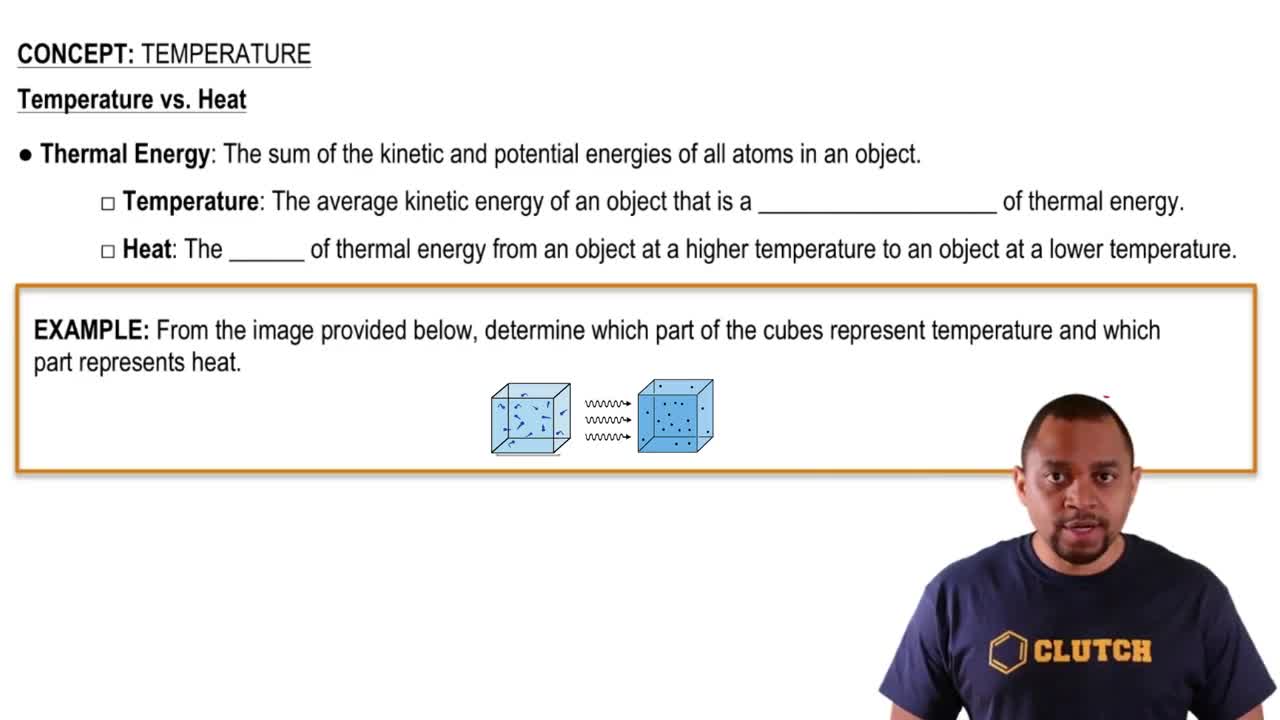
The temperature of an object affects the energy levels of its atoms and, consequently, its emission spectrum. The Sun's surface temperature is around 5,500 degrees Celsius, resulting in a spectrum dominated by high-energy emissions. In contrast, the Earth's lower temperature leads to different energy transitions, producing a spectrum that reflects its cooler, more complex environment.
Video consigliato:
Percorso guidato
Temperature vs Heat
Pratica correlata
Domanda del libro di testo
1448
views
Domanda del libro di testo
Orbital energies in single-electron atoms or ions, such as He+, can be described with an equation similar to the Balmer–Rydberg equation:
where Z is the atomic number. What wavelength of light in nanometers is emitted when the electron in He+ falls from n = 3 to n = 2?
698
views
Domanda del libro di testo
Imagine a universe in which the four quantum numbers can have the same possible values as in our universe except that the angular-momentum quantum number l can have integral values of 0, 1, 2...n + 1 (instead of 0, 1, 2..., n - 1). (a) How many elements would be in the first two rows of the periodic table in this universe?
1637
views
Domanda del libro di testo
Order the following atoms according to increasing atomic radius: Rb, Cl, As, K.
1099
views
Domanda del libro di testo
Fill in the blanks with the appropriate region of electromagnetic
radiation: UV, visible, infrared.
(a) The Sun most strongly emits in the _____ and
regions of electromagnetic radiation
(b) The atmosphere filters out biologically damaging ______
radiation from incoming solar radiation
and prevents it from reaching Earth.
(c) The Earth most strongly emits ______ radiation.
(d) Greenhouse gases absorb _______ radiation.
1273
views
Domanda del libro di testo
Imagine a universe in which the four quantum numbers can have the same possible values as in our universe except that the angular-momentum quantum number l can have integral values of 0, 1, 2...n + 1 (instead of 0, 1, 2..., n - 1). (c) Draw an orbital-filling diagram for the element with atomic number 12.
384
views