Element X reacts with element Y to give a product containing X3+ ions and Y2-ions. (d) In what groups of the periodic table are elements X and Y likely to be found?
Ch.6 - Ionic Compounds: Periodic Trends and Bonding Theory
Tutti i libri di testo
McMurry 8th Edition
Ch.6 - Ionic Compounds: Periodic Trends and Bonding Theory
Problema 78b
McMurry 8th Edition
Ch.6 - Ionic Compounds: Periodic Trends and Bonding Theory
Problema 78bCapitolo 6, Problema 78b
Element X reacts with element Y to give a product containing X3+ ions and Y2-ions. (b) Is element Y likely to be a metal or a nonmetal? Explain.
Guida verificata passo dopo passo1
Identify the charges on the ions formed in the reaction. Here, X forms X3+ ions and Y forms Y2- ions.
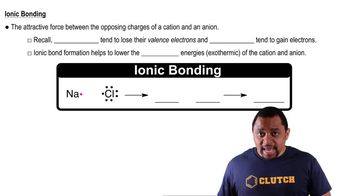
Recall that metals tend to lose electrons and form positively charged cations, while nonmetals tend to gain electrons and form negatively charged anions.
Analyze the charge on the Y ion. Since Y forms Y2- ions, it gains electrons.
Compare the behavior of Y with typical properties of metals and nonmetals. Gaining electrons is a characteristic of nonmetals.
Conclude that element Y is likely to be a nonmetal because it forms anions by gaining electrons.

Risposta video verificata per un problema simile:
Questa soluzione video è stata consigliata dai nostri tutor come utile per risolvere questo problema.
Durata del video:
1mConcetti chiave
Ecco i concetti essenziali che devi comprendere per rispondere correttamente alla domanda.
Ionic Bonding
Ionic bonding occurs when atoms transfer electrons, resulting in the formation of charged ions. In this case, element Y forms Y2- ions, indicating it has gained two electrons, which is characteristic of nonmetals. The attraction between the positively charged X3+ ions and negatively charged Y2- ions leads to the formation of an ionic compound.
Video consigliato:
Percorso guidato
Chemical Bonds
Metal vs. Nonmetal Properties
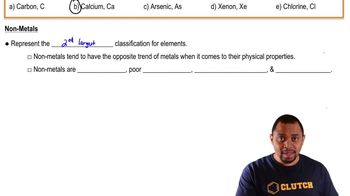
Metals are typically characterized by their ability to lose electrons easily, forming positive ions, while nonmetals tend to gain electrons to form negative ions. The formation of Y2- ions suggests that element Y is likely a nonmetal, as nonmetals are more electronegative and prefer to gain electrons to achieve a stable electron configuration.
Video consigliato:
Percorso guidato
Nonmetal Properties
Electronegativity
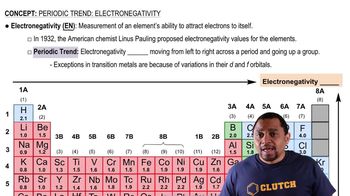
Electronegativity is a measure of an atom's ability to attract and hold onto electrons. Nonmetals generally have higher electronegativities compared to metals, which allows them to gain electrons and form anions. In this reaction, the formation of Y2- ions indicates that element Y has a high electronegativity, supporting the conclusion that it is a nonmetal.
Video consigliato:
Percorso guidato
Electronegativity Trends
Pratica correlata
Domanda del libro di testo
469
views
Domanda del libro di testo
Each of the following pairs of elements will react to form a binary ionic compound. Write the formula of each compound formed, and give its name. (c) Lithium and nitrogen
607
views
Domanda del libro di testo
Each of the following pairs of elements will react to form a binary ionic compound. Write the formula of each compound formed, and give its name. (d) Barium and flourine
435
views
Domanda del libro di testo
Element X reacts with element Y to give a product containing X3+ ions and Y2- ions. (c) What is the formula of the product?
423
views
Domanda del libro di testo
Element X reacts with element Y to give a product containing X3+ ions and Y2-ions. (a) Is element X likely to be a metal or a nonmetal? Explain.
370
views