
Ch.6 - Ionic Compounds: Periodic Trends and Bonding Theory
McMurry - Chemistry 8th Edition
McMurry8th EditionChemistryISBN: 9781292336145Non è quello che usi tu?Cambia libro di testo
Capitolo 6, Problema 12a

Given the following information, construct a Born–Haber cycle to calculate the lattice energy of CaCl2(s). (LO 6.13)
Net energy change for the formation of CaCl2(s) form Ca(s) and Cl2(g) = -795.4 kJ/mol
Heat of sublimation for Ca(s) = +178 kJ/mol
Ei1 for Ca(s) = +590 kJ/mol
Ei2 for Ca(g) = +1145 kJ/mol
Bond dissociation energy for Cl2(g) = +243 kJ/mol
Eea1 for Cl(g) = -348.6 kJ/mol
(a) 2603 kJ/mol (b) 2254 kJ/mol (c) 2481 kJ/mo (d) 1663 kJ/mol

Guida verificata passo dopo passo
1
Step 1: Start by writing the formation equation for CaCl2(s) from its elements in their standard states: Ca(s) + Cl2(g) → CaCl2(s).
Step 2: Include the given enthalpy change for the formation of CaCl2(s), which is -795.4 kJ/mol. This value represents the overall energy change for the reaction.
Step 3: Add the individual steps and their corresponding energies to the cycle: sublimation of Ca(s) to Ca(g) (+178 kJ/mol), first ionization energy of Ca(g) to Ca+(g) (+590 kJ/mol), second ionization energy of Ca+(g) to Ca2+(g) (+1145 kJ/mol), bond dissociation of Cl2(g) to 2Cl(g) (+243 kJ/mol), and electron affinity of Cl(g) to form Cl-(g) (-348.6 kJ/mol for each Cl, total -697.2 kJ/mol for two Cl atoms).
Step 4: Arrange these steps around a cycle, connecting the initial reactants to the final product, CaCl2(s), ensuring that the cycle balances both mass and charge.
Step 5: Solve for the lattice energy of CaCl2(s) by using Hess's Law, which states that the total enthalpy change for the cycle must equal zero. Rearrange the equation to solve for the lattice energy, which is the only unknown in the cycle.

Risposta video verificata per un problema simile:

Questa soluzione video è stata consigliata dai nostri tutor come utile per risolvere questo problema.
Durata del video:
8m

Concetti chiave

Ecco i concetti essenziali che devi comprendere per rispondere correttamente alla domanda.

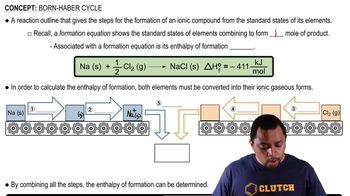
Born-Haber Cycle

The Born-Haber cycle is a thermodynamic cycle that relates the lattice energy of an ionic compound to the enthalpy changes involved in its formation from its constituent elements. It combines various energy changes, including sublimation, ionization, bond dissociation, and electron affinity, to calculate the lattice energy, which is the energy released when gaseous ions form a solid ionic lattice.
Video consigliato:
Percorso guidato
03:49
Born Haber Cycle

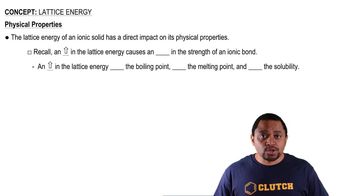
Lattice Energy

Lattice energy is the amount of energy released when one mole of an ionic solid is formed from its gaseous ions. It is a measure of the strength of the forces between the ions in an ionic compound. A higher lattice energy indicates a more stable ionic compound, as it reflects stronger ionic bonds due to greater charge and smaller ionic radii.
Video consigliato:

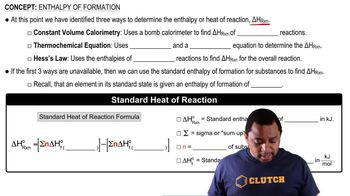
Enthalpy Changes

Enthalpy changes are the heat changes that occur during chemical reactions or phase changes at constant pressure. In the context of the Born-Haber cycle, these include the heat of sublimation, ionization energies, bond dissociation energies, and electron affinities. Understanding these enthalpy changes is crucial for accurately calculating the overall energy change associated with the formation of ionic compounds.
Video consigliato:
Percorso guidato
02:34
Enthalpy of Formation