Ch.6 - Ionic Compounds: Periodic Trends and Bonding Theory
McMurry - Chemistry 8th Edition
McMurry8th EditionChemistryISBN: 9781292336145Non è quello che usi tu?Cambia libro di testo
Capitolo 6, Problema 11

Which molecular scale image best represents the ionic com-pound that forms between cesium and chlorine? (Cesium is represented by red circles, and chlorine is represented by blue circles.) (LO 6.12) (a)
(b)
(c)
(d)

Guida verificata passo dopo passo
1
Step 1: Identify the type of bond that forms between cesium and chlorine. Cesium (Cs) is a metal and chlorine (Cl) is a non-metal. When a metal and a non-metal react, they form an ionic bond.
Step 2: Determine the charges of the ions. Cesium loses one electron to achieve a stable electron configuration, forming a Cs+ ion. Chlorine gains one electron to achieve a stable electron configuration, forming a Cl- ion.
Step 3: Consider the ratio of ions in the compound. In an ionic compound, the total positive charge must equal the total negative charge. Since Cs+ and Cl- have charges of +1 and -1 respectively, the ratio of Cs to Cl in the compound is 1:1.
Step 4: Look at the molecular scale images provided. The correct image will show a 1:1 ratio of red (cesium) to blue (chlorine) circles, representing the Cs+ and Cl- ions.
Step 5: Remember that in an ionic compound, the ions arrange themselves in a regular repeating pattern called a crystal lattice. The correct image will also show this pattern.

Risposta video verificata per un problema simile:

Questa soluzione video è stata consigliata dai nostri tutor come utile per risolvere questo problema.
Durata del video:
1m

Concetti chiave

Ecco i concetti essenziali che devi comprendere per rispondere correttamente alla domanda.

Ionic Bonding

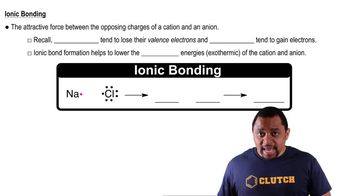
Ionic bonding occurs when one atom donates an electron to another, resulting in the formation of positively and negatively charged ions. In the case of cesium and chlorine, cesium (a metal) loses an electron to become a Cs+ ion, while chlorine (a non-metal) gains an electron to become a Cl- ion. The electrostatic attraction between these oppositely charged ions forms a stable ionic compound.
Video consigliato:

Molecular Representation

Molecular representations visually depict the arrangement of atoms in a compound. In this context, red circles represent cesium ions and blue circles represent chloride ions. Understanding how these ions are arranged in a lattice structure is crucial for identifying the correct molecular scale image that illustrates the ionic compound formed between cesium and chlorine.
Video consigliato:
Percorso guidato
02:38
Molecular Polarity

Lattice Structure

Ionic compounds typically form a crystalline lattice structure, where ions are arranged in a repeating three-dimensional pattern. This arrangement maximizes the attractive forces between oppositely charged ions while minimizing repulsive forces between like charges. Recognizing this structure is essential for visualizing how cesium and chlorine ions interact in the ionic compound, influencing the choice of the correct molecular scale image.
Video consigliato:
Pratica correlata
Domanda del libro di testo
Which of the following processes will release the most energy? (LO 6.9) (a) (b) (c) (d)
337
views

Domanda del libro di testo

Given the following information, construct a Born–Haber cycle to calculate the lattice energy of CaCl2(s). (LO 6.13)

Net energy change for the formation of CaCl2(s) form Ca(s) and Cl2(g) = -795.4 kJ/mol

Heat of sublimation for Ca(s) = +178 kJ/mol

Ei1 for Ca(s) = +590 kJ/mol

Ei2 for Ca(g) = +1145 kJ/mol

Bond dissociation energy for Cl2(g) = +243 kJ/mol

Eea1 for Cl(g) = -348.6 kJ/mol

(a) 2603 kJ/mol (b) 2254 kJ/mol (c) 2481 kJ/mo (d) 1663 kJ/mol

708
views
Domanda del libro di testo
Which element has the largest atomic radius? (LO 5.20) (a) Rb (b) Co (c) Mg d) As
917
views
Domanda del libro di testo
Elements that have large negative electron affinities generally have (LO 6.10) (a) high values for Zeff and a vacancy in a valence orbital. (b) low values for Zeff and a vacancy in a valence orbital. (c) high values for Zeff and filled valence orbitals. (d) low values for Zeff and filled valence orbitals.
443
views
Domanda del libro di testo
For a multielectron atom, a 3s orbital lies lower in energy than a 3p orbital because (LO 5.16) (a) a 3p orbital has more nodal surfaces than a 3s orbital. (b) an electron in a 3p orbital has a higher probability of being closer to the nucleus than an electron in a 3s orbital. (c) inner electrons shield electrons in a 3p orbital more effec-tively than electrons in a 3s orbital. (d) the energy of the electron can be spread between three 3p orbitals instead of only one 3s orbital.
1786
views
Domanda del libro di testo

Predict the formula of the ionic compound that forms between potassium and sulfur. (LO 6.11) (a) KS (b) KS2 (c) K2S2 (d) K2S

832
views