Each of the following pairs of elements will react to form a binary ionic compound. Write the formula of each compound formed, and give its name. (c) Lithium and nitrogen
Ch.6 - Ionic Compounds: Periodic Trends and Bonding Theory
Tutti i libri di testo
McMurry 8th Edition
Ch.6 - Ionic Compounds: Periodic Trends and Bonding Theory
Problema 75
McMurry 8th Edition
Ch.6 - Ionic Compounds: Periodic Trends and Bonding Theory
Problema 75Capitolo 6, Problema 75
What noble-gas configurations and charges are the following elements likely to attain in reactions in which they form ions? (a) I (b) O (c) Al (d) Ca
Guida verificata passo dopo passo1
Identify the position of each element in the periodic table to determine how many electrons they need to gain or lose to achieve a noble-gas configuration.
For iodine (I), which is in Group 17, determine how many electrons it needs to gain to achieve the electron configuration of the nearest noble gas, xenon (Xe).
For oxygen (O), which is in Group 16, determine how many electrons it needs to gain to achieve the electron configuration of the nearest noble gas, neon (Ne).
For aluminum (Al), which is in Group 13, determine how many electrons it needs to lose to achieve the electron configuration of the nearest noble gas, neon (Ne).
For calcium (Ca), which is in Group 2, determine how many electrons it needs to lose to achieve the electron configuration of the nearest noble gas, argon (Ar).
Concetti chiave
Ecco i concetti essenziali che devi comprendere per rispondere correttamente alla domanda.
Noble Gas Configuration
Noble gas configuration refers to the electron arrangement of noble gases, which have full outer electron shells, making them stable and unreactive. Elements tend to achieve this configuration by gaining, losing, or sharing electrons during chemical reactions. For example, sodium (Na) loses one electron to attain the same configuration as neon (Ne), resulting in a stable ion.
Video consigliato:
Percorso guidato
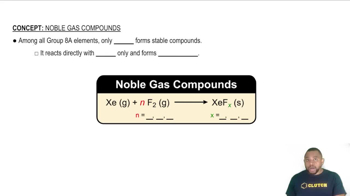
Noble Gas Compounds
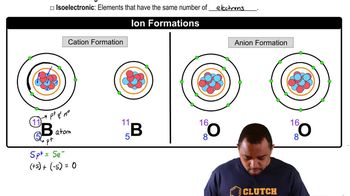
Ion Formation and Charges
Ion formation occurs when atoms gain or lose electrons, resulting in charged particles called ions. Metals typically lose electrons to form positively charged cations, while nonmetals gain electrons to form negatively charged anions. The charge of the ion reflects the number of electrons lost or gained; for instance, oxygen (O) usually gains two electrons to form an O²⁻ ion.
Video consigliato:
Percorso guidato
Ion Formation
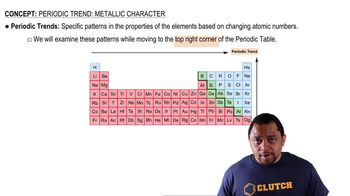
Periodic Trends in Reactivity
Periodic trends in reactivity refer to the predictable patterns in how elements behave based on their position in the periodic table. Elements in the same group often exhibit similar reactivity due to their valence electron configurations. For example, alkali metals are highly reactive because they have one electron in their outer shell, while noble gases are largely inert due to their full outer shells.
Video consigliato:
Percorso guidato
Periodic Trends
Pratica correlata
Domanda del libro di testo
459
views
Domanda del libro di testo
Each of the following pairs of elements will react to form a binary ionic compound. Write the formula of each compound formed, and give its name. (a) Magnesium and chlorine
481
views
Domanda del libro di testo
What noble-gas configurations and charge are the following elements likely to attain in reactions in which they form ions? (a) N (c) S (d) Br
791
views
Domanda del libro di testo
What noble-gas configurations and charge are the following elements likely to attain in reactions in which they form ions? (b) Ca
437
views
Domanda del libro di testo
Each of the following pairs of elements will react to form a binary ionic compound. Write the formula of each compound formed, and give its name. (b) Calcium and oxygen
468
views