Determine whether or not the mixing of each pair of solutions results in a buffer. d. 175.0 mL of 0.10 M NH3; 150.0 mL of 0.12 M NaOH
Ch.17 - Aqueous Ionic Equilibrium
Tro4th EditionChemistry: A Molecular ApproachISBN: 9780134112831Non è quello che usi tu?Cambia libro di testo
Capitolo 17, Problema 54a,b,d
Determine whether or not the mixing of each pair of solutions results in a buffer. a. 75.0 mL of 0.10 M HF; 55.0 mL of 0.15 M NaF b. 150.0 mL of 0.10 M HF; 135.0 mL of 0.175 M HCl d. 125.0 mL of 0.15 M CH3NH2; 120.0 mL of 0.25 M CH3NH3Cl
Guida verificata passo dopo passo1
Identify the components needed for a buffer solution: a weak acid and its conjugate base, or a weak base and its conjugate acid.
Recognize that HF is a weak acid, which is a potential component of a buffer solution.
Note that HCl is a strong acid, which will completely dissociate in solution and does not form a buffer with HF.
Calculate the moles of HF: \( \text{moles of HF} = 0.150 \text{ L} \times 0.10 \text{ M} \).
Calculate the moles of HCl: \( \text{moles of HCl} = 0.135 \text{ L} \times 0.175 \text{ M} \).

Risposta video verificata per un problema simile:
Questa soluzione video è stata consigliata dai nostri tutor come utile per risolvere questo problema.
Durata del video:
2mConcetti chiave
Ecco i concetti essenziali che devi comprendere per rispondere correttamente alla domanda.
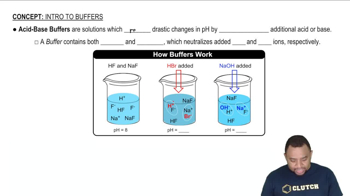
Buffer Solutions
A buffer solution is a system that resists changes in pH upon the addition of small amounts of acid or base. It typically consists of a weak acid and its conjugate base or a weak base and its conjugate acid. Buffers are crucial in maintaining stable pH levels in various chemical and biological processes.
Video consigliato:
Percorso guidato
Buffer Solutions
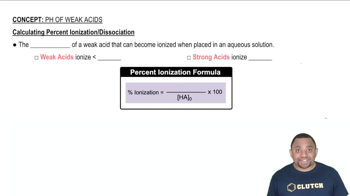
Weak Acids and Strong Acids
Weak acids, like HF (hydrofluoric acid), partially dissociate in solution, establishing an equilibrium between the undissociated acid and its ions. In contrast, strong acids, such as HCl (hydrochloric acid), completely dissociate in solution. The presence of a strong acid can disrupt the equilibrium of a weak acid, affecting the buffer capacity.
Video consigliato:
Percorso guidato
Calculating Percent Ionization of Weak Acids
pH and Acid-Base Reactions
pH is a measure of the hydrogen ion concentration in a solution, indicating its acidity or basicity. Acid-base reactions involve the transfer of protons (H+) between species, influencing the pH. Understanding how the mixing of different acids affects the overall pH is essential for determining whether a buffer is formed.
Video consigliato:
Percorso guidato
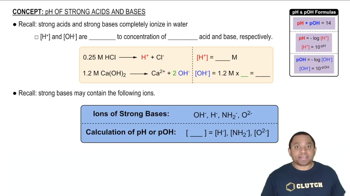
pH of Strong Acids and Bases
Pratica correlata
Domanda del libro di testo
385
views
Domanda del libro di testo
Determine whether or not the mixing of each pair of solutions results in a buffer. c. 165.0 mL of 0.10 M HF; 135.0 mL of 0.050 M KOH
487
views
Domanda del libro di testo
Determine whether or not the mixing of each pair of solutions results in a buffer. e. 105.0 mL of 0.15 M CH3NH2; 95.0 mL of 0.10 M HCl
738
views
Domanda del libro di testo
Blood is buffered by carbonic acid and the bicarbonate ion. Normal blood plasma is 0.024 M in HCO3- and 0.0012 M H2CO3 (pKa1 for H2CO3 at body temperature is 6.1).
a. What is the pH of blood plasma?
1608
views
Domanda del libro di testo
Determine whether or not the mixing of each pair of solutions results in a buffer. e. 125.0 mL of 0.15 M NH3; 150.0 mL of 0.20 M NaOH
528
views
Domanda del libro di testo
Determine whether or not the mixing of each pair of solutions results in a buffer. c. 50.0 mL of 0.15 M HF; 20.0 mL of 0.15 M NaOH
393
views