Ch.17 - Aqueous Ionic Equilibrium
Tro - Chemistry: A Molecular Approach 4th Edition
Tro4th EditionChemistry: A Molecular ApproachISBN: 9780134112831Non è quello che usi tu?Cambia libro di testo
Capitolo 17, Problema 53c

Determine whether or not the mixing of each pair of solutions results in a buffer. c. 50.0 mL of 0.15 M HF; 20.0 mL of 0.15 M NaOH

Guida verificata passo dopo passo
1
Identify the components of the solutions: HF is a weak acid and NaOH is a strong base.
Calculate the moles of HF using the formula: moles = concentration \( \times \) volume. For HF, use 0.15 M and 50.0 mL.
Calculate the moles of NaOH using the formula: moles = concentration \( \times \) volume. For NaOH, use 0.15 M and 20.0 mL.
Determine the limiting reactant by comparing the moles of HF and NaOH. The limiting reactant will be completely consumed in the reaction.
Check if the remaining solution contains a weak acid and its conjugate base. If so, the solution is a buffer.

Risposta video verificata per un problema simile:

Questa soluzione video è stata consigliata dai nostri tutor come utile per risolvere questo problema.
Durata del video:
6m

Concetti chiave

Ecco i concetti essenziali che devi comprendere per rispondere correttamente alla domanda.

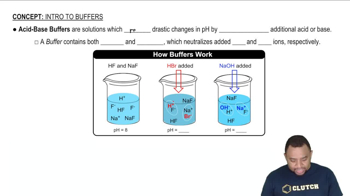
Buffer Solutions

A buffer solution is a system that resists changes in pH upon the addition of small amounts of acid or base. It typically consists of a weak acid and its conjugate base or a weak base and its conjugate acid. Buffers maintain pH stability, which is crucial in many chemical and biological processes.
Video consigliato:
Percorso guidato
03:02
Buffer Solutions

Weak Acids and Bases

Weak acids, like hydrofluoric acid (HF), do not completely dissociate in solution, meaning they establish an equilibrium between the undissociated acid and its ions. In contrast, strong bases, such as sodium hydroxide (NaOH), fully dissociate in solution. The interaction between weak acids and strong bases is essential for buffer formation.
Video consigliato:
Percorso guidato
00:51
ICE Charts of Weak Bases

Neutralization Reaction

A neutralization reaction occurs when an acid reacts with a base to produce water and a salt. In the context of the given question, the reaction between HF and NaOH will lead to the formation of water and sodium fluoride (NaF). This reaction is critical in determining whether the resulting solution can act as a buffer.
Video consigliato:
Percorso guidato
05:56
Lewis Dot Structures: Neutral Compounds