
Determine whether or not the mixing of each pair of solutions results in a buffer. a. 75.0 mL of 0.10 M HF; 55.0 mL of 0.15 M NaF b. 150.0 mL of 0.10 M HF; 135.0 mL of 0.175 M HCl d. 125.0 mL of 0.15 M CH3NH2; 120.0 mL of 0.25 M CH3NH3Cl
Ch.17 - Aqueous Ionic Equilibrium
Tro4th EditionChemistry: A Molecular ApproachISBN: 9780134112831Non è quello che usi tu?Cambia libro di testo
Capitolo 17, Problema 53d
Determine whether or not the mixing of each pair of solutions results in a buffer. d. 175.0 mL of 0.10 M NH3; 150.0 mL of 0.12 M NaOH
Guida verificata passo dopo passo1
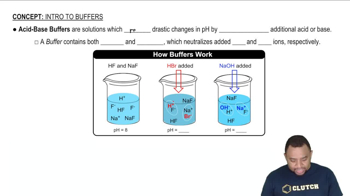
Identify the components needed for a buffer solution: a weak acid and its conjugate base, or a weak base and its conjugate acid.
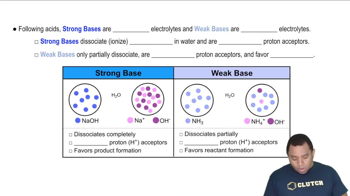
Recognize that NH3 (ammonia) is a weak base and NaOH (sodium hydroxide) is a strong base.
Understand that a buffer solution requires a weak base and its conjugate acid, not a strong base.
Calculate the moles of NH3: \( \text{moles of NH3} = 0.175 \text{ L} \times 0.10 \text{ M} \).
Calculate the moles of NaOH: \( \text{moles of NaOH} = 0.150 \text{ L} \times 0.12 \text{ M} \).

Risposta video verificata per un problema simile:
Questa soluzione video è stata consigliata dai nostri tutor come utile per risolvere questo problema.
Durata del video:
6mConcetti chiave
Ecco i concetti essenziali che devi comprendere per rispondere correttamente alla domanda.
Buffer Solutions
A buffer solution is a system that resists changes in pH upon the addition of small amounts of acid or base. It typically consists of a weak acid and its conjugate base or a weak base and its conjugate acid. Buffers are crucial in maintaining stable pH levels in various chemical and biological processes.
Video consigliato:
Percorso guidato
Buffer Solutions
Weak Bases and Strong Bases
Weak bases, like ammonia (NH3), partially ionize in solution, establishing an equilibrium between the base and its conjugate acid (NH4+). In contrast, strong bases, such as sodium hydroxide (NaOH), fully dissociate in solution, leading to a significant increase in hydroxide ions (OH-). Understanding the behavior of these bases is essential for determining buffer capacity.
Video consigliato:
Percorso guidato
Strong vs Weak Bases
Concentration and Volume in Solution Chemistry
The concentration of a solution, expressed in molarity (M), indicates the amount of solute per liter of solution. When mixing solutions, the total volume and the concentrations of the individual components must be considered to determine the final concentrations of the resulting mixture. This is important for assessing whether the mixture can act as a buffer.
Video consigliato:
Percorso guidato
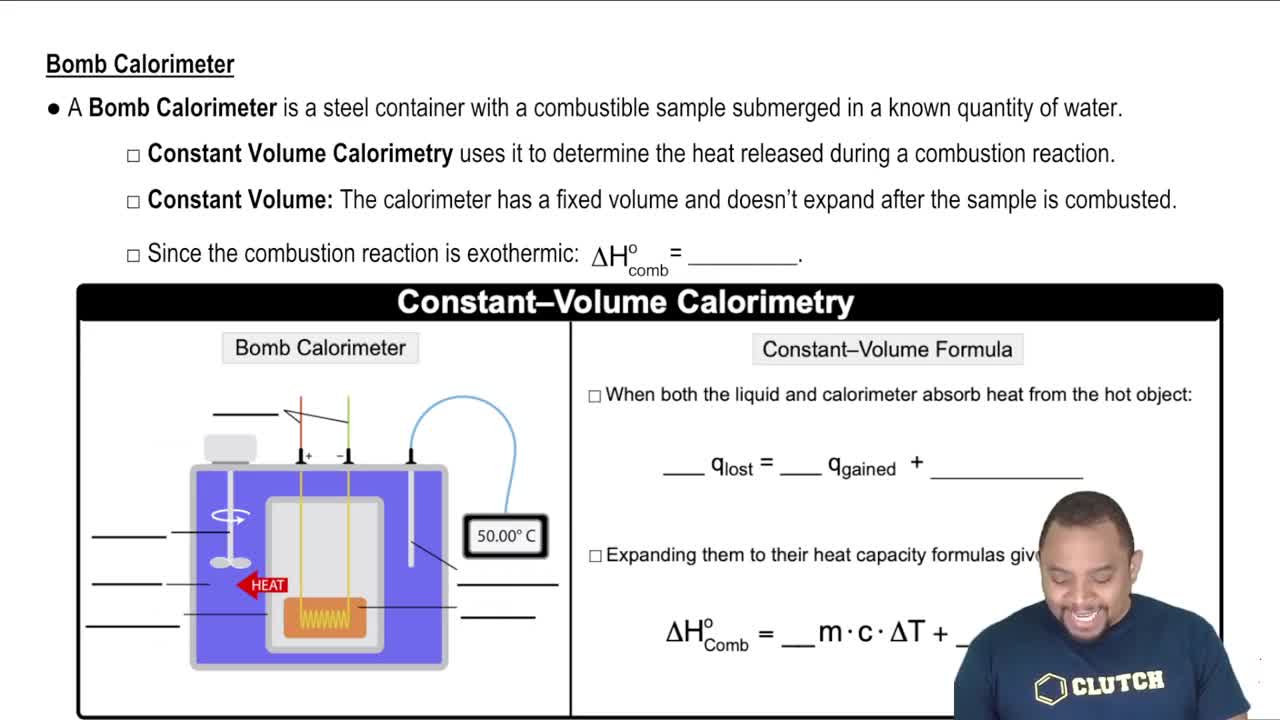
Constant-Volume Calorimetry
Pratica correlata
Domanda del libro di testo
2588
views
1
rank
Domanda del libro di testo
Determine whether or not the mixing of each pair of solutions results in a buffer. b. 50.0 mL of 0.10 M HCl; 35.0 mL of 0.150 M NaOH
472
views
Domanda del libro di testo
Determine whether or not the mixing of each pair of solutions results in a buffer. c. 165.0 mL of 0.10 M HF; 135.0 mL of 0.050 M KOH
487
views
Domanda del libro di testo
Determine whether or not the mixing of each pair of solutions results in a buffer. a. 100.0 mL of 0.10 M NH3; 100.0 mL of 0.15 M NH4Cl
637
views
Domanda del libro di testo
Determine whether or not the mixing of each pair of solutions results in a buffer. e. 125.0 mL of 0.15 M NH3; 150.0 mL of 0.20 M NaOH
528
views
Domanda del libro di testo
Determine whether or not the mixing of each pair of solutions results in a buffer. c. 50.0 mL of 0.15 M HF; 20.0 mL of 0.15 M NaOH
393
views
